.avif)


¡Transformamos los prodigios de hoy en íconos del mañana!



The Format: Nine Groups, Expanded Opportunities
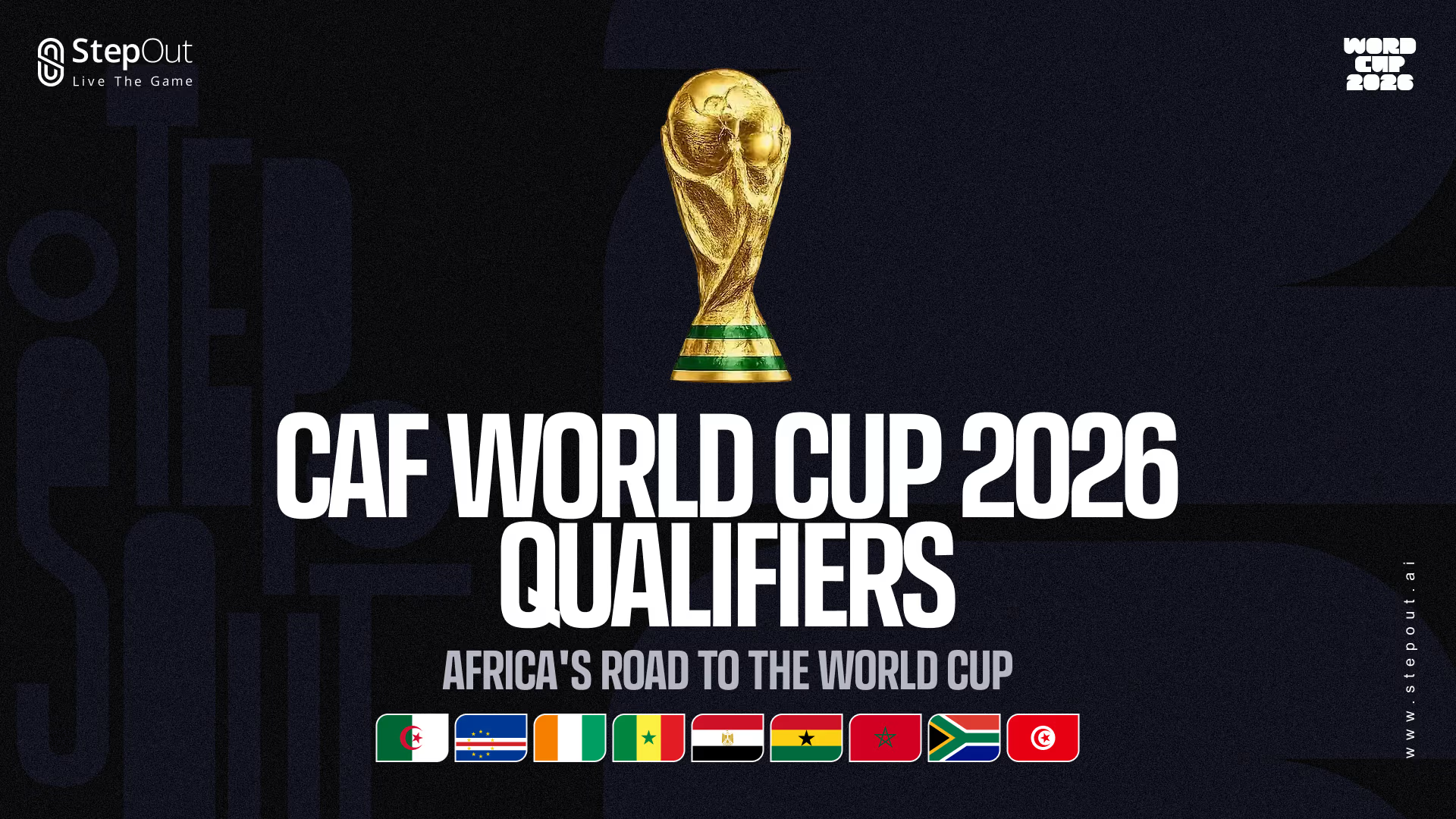
CAF's qualification process for 2026 was straightforward in structure. Fifty-four member associations entered the competition, divided into nine groups of six teams. Each group played a full home-and-away round-robin across ten matchdays, running from November 2023 through October 2025. The nine group winners earned direct World Cup qualification. The four best runners-up advanced to the CAF playoff semifinals, with the playoff final winner earning a berth in the inter-confederation playoff tournament — not a direct World Cup spot, but a final-stage opportunity. The expansion to nine direct African slots created qualification pathways that would not have existed in previous cycles, enabling Cape Verde's historic qualification and giving nations like South Africa a genuine route to the tournament's final stages on merit.

The Nine Qualifiers: Group by Group
Morocco Africa's highest-ranked nation and the continent's most analytically complete side entered qualification as heavy favourites in their group — and delivered accordingly. Morocco's route to the World Cup is defined not by any drama in the African qualifying process, but by the reputation they carry into it: a 2022 World Cup semifinalist, built on defensive structural excellence and transition efficiency. Their coach's system remains one of the most data-consistent in African football. Morocco defend deep, compact, and with extraordinary collective organisation, then transition with pace and purpose. Open-play expected goal data from their qualifying campaign shows they consistently outperformed opponents in both defensive duels won and counter-attack sequence completion. Senegal Senegal qualified as African champions with a squad that has fully matured into one of the continent's most comprehensive teams. The balance of their current generation — Sadio Mané's successor generation combining with experienced CAF-proven defenders — reflects a programme that has built genuine structural depth rather than reliance on a single player. Their pressing identity, built around collective work rate and physical intensity, is among the highest in the continental field. Qualification data showed Senegal among the top three CAF sides in pressing actions per 90 minutes — a metric that translates directly to their capacity to apply pressure against technically superior European and South American opponents. Egypt Egypt's qualification was built largely around the gravitational pull of Mohamed Salah at the peak of his global profile, but the squad's structural development under their coaching setup has produced genuine depth in wide areas and a more reliable defensive block than previous Egyptian World Cup campaigns carried. Salah's individual quality is not a crutch — it is the ceiling of a system that functions well without him. Their group-stage fixture in Group G against Belgium will be one of the tournament's most widely watched matches: a potential last World Cup for Salah against Kevin De Bruyne, two generational players in the same pool. Algeria Algeria qualified with characteristic tactical discipline — a squad built on Ligue 1 and Bundesliga midfield quality, defensively organised and technically capable in tight spaces. Their qualification campaign was methodical rather than spectacular, accumulating points through consistency in both home and away fixtures. At the World Cup, Algeria face Argentina in Group J — a fixture that represents a significant step up in quality but also a genuine opportunity for what has become one of CAF's more sophisticated tactical setups. Ivory Coast Ivory Coast's qualification was built on the generation that followed the Drogba era. Their current squad combines Premier League and Ligue 1 physicality with a tactical identity focused on direct, high-intensity pressing and explosive transition. Their campaign showed consistent performance across the full ten-matchday cycle — no significant dips, no results that indicated structural vulnerability. Their group-stage fixture against Germany in Group E is the tournament's most compelling confederation clash: two physical, technically gifted sides whose tactical models share enough overlap to produce a genuinely contested 90 minutes. Ghana Ghana return to the World Cup having last appeared in Qatar 2022, where they exited in the group stage. Their current squad retains the athletic directness and aggressive pressing that defines their qualification identity, alongside more technical quality in midfield than the 2022 group carried. Group L — England, Croatia, Panama — provides no comfortable fixtures, but Ghana have historically outperformed their tournament ranking in the group stage. Their fixture against England will be the match Ghana supporters anticipate most. South Africa South Africa qualified on merit for the first time since 2002 — a landmark result for a programme that has spent much of the past two decades rebuilding its competitive infrastructure. Their qualification through the CAF group stage, finishing ahead of more fancied opponents on multiple occasions, reflects genuine structural progress rather than fortunate draw outcomes. Tactically, South Africa's squad is built around domestic-league intensity and physical organisation — a model that makes them competitive in the African context but will face significantly elevated challenges at the World Cup. Their Group A fixture against Mexico at the Estadio Azteca carries historical symmetry with the 2010 opener. Tunisia Tunisia's qualification was hard-fought — their group stage required consistent performance across all ten matchdays, with several fixtures decided by narrow margins. Their squad, led by the technically gifted Hannibal Mejbri at Manchester City, represents a generation of European-based talent returning to the national programme with club football quality that was not available to previous generations. They face Netherlands, Japan, and Sweden in Group F — arguably the most competitive pool for any African side in the tournament. Cape Verde Cape Verde are the qualification cycle's most celebrated African story. A small island nation with a population of approximately 600,000, their direct qualification for the World Cup — earning a full group-stage spot outright rather than requiring a playoff — is a landmark in the confederation's history. Their football is built around Portuguese-league-based talent and a physical, direct style that overachieves against more technically polished opponents. Group H — Spain, Uruguay, Saudi Arabia — offers no easy match, but Cape Verde's presence in the group is earned and genuine.
The Notable Absences: Nigeria and Cameroon
Nigeria's failure to qualify is the biggest shock of African football's 2026 cycle. The Super Eagles, a perennial World Cup presence with five previous appearances, were eliminated in the CAF playoff semifinals — beaten by South Africa in a two-legged tie that exposed their structural fragility at the back and their over-reliance on individual attacking brilliance without collective defensive cohesion. Nigeria's absence reflects a broader structural issue: the programme has struggled to translate its extraordinary talent pipeline — Premier League and Bundesliga-based players of genuine quality — into a coherent, consistent national team system. Individual quality has not consistently translated into collective identity, and the playoff format punished that gap. Cameroon's exit is equally striking. Eliminated by DR Congo in the inter-confederation playoff route, losing in what many considered an upset, the Indomitable Lions' inability to convert their historical pedigree into a 2026 qualification reflects generational transition challenges and inconsistent structural investment in the national programme. Both absences create space at the World Cup for nations whose qualification reflects genuine current merit — and put pressure on CAF's established powers to address development infrastructure in the next cycle.
DR Congo: The Playoff Route to Potential History
DR Congo's route to the World Cup was one of the qualification cycle's most remarkable stories. Having finished as one of the four best CAF runners-up, they advanced to the playoff semifinals — then beat Nigeria on penalties in the CAF playoff final to earn a berth in the inter-confederation tournament. In the inter-confederation playoff, they ultimately qualified for the World Cup by winning their path — potentially making Africa's total ten nations, an unprecedented number for the continent. Tactically, DR Congo are physically dominant, intensely motivated, and increasingly sophisticated in their defensive structure. Their Group K assignment alongside Portugal and Colombia is, on paper, the most difficult group any African side has been placed in — but for a team that eliminated Nigeria and then won an inter-confederation playoff, the context is defined by the achievement of being present.
Tactical Trends Across CAF Qualification
Several analytical patterns emerged from Africa's qualification campaign that carry implications for understanding the World Cup field. Defensive organisation is converging across the continent's top tier. The nine direct qualifiers all performed in the top tier of CAF's goals-against metrics. African football's tactical evolution over the past decade has prioritised defensive structure — a shift from the expansive, attack-first identity of earlier generations toward more systematic pressing and positional discipline. Set-piece delivery was a significant goals-per-match driver. Morocco and Senegal — the two highest-ranked African qualifiers — produced disproportionate returns from set-piece situations relative to their open-play expected goal data. This mirrors the trend seen in European qualification and reinforces that set-piece execution is among the most analytically significant performance differentiators in high-stakes international football. European-based squads qualified more consistently than domestically-based ones. Among the nine direct qualifiers, the squads with the highest proportion of European-league-based players showed lower performance variance across the full campaign — fewer dropped points in away fixtures, more consistent defensive shape under pressure. This reflects the positional training and pressing structure embedded in European club environments filtering into national team tactical identity.
Africa's World Cup Profile: What the Nine Qualifiers Represent
The 2026 field is the most tactically diverse and geographically representative African World Cup contingent in history. From Morocco's established tactical sophistication to Cape Verde's resource-efficient directness, from Senegal's collective pressing to Egypt's individual-driven system, the nine qualifiers cover a wider spectrum of football identity than any previous African contingent. Morocco and Senegal carry the realistic expectation of reaching the knockout stages — and potentially going further. Egypt's individual quality through Salah gives them an upset capacity in any group-stage fixture. The remaining six all carry competitive identities that make them genuinely difficult opponents rather than simply filling expanded-format slots. For CAF's development mission, the nine-slot allocation creates a structural lever: World Cup exposure accelerates player development, coaching evolution, and commercial investment in national programmes in ways that qualification alone cannot replicate.
Conclusion
Africa's road to the 2026 World Cup was defined by expanded opportunity, competitive drama, and landmark outcomes. Nine direct qualifiers, DR Congo's potential tenth via the inter-confederation playoff, and the historic absences of Nigeria and Cameroon — all of it reflecting a continental football landscape in genuine structural transition. The nine nations who arrive in North America carry the continent's most significant collective World Cup opportunity in decades. Whether they convert that opportunity into deep tournament runs will be among 2026's most compelling analytical questions.
Access in-depth performance data, tactical intelligence, and AI-driven match insights for your team.