
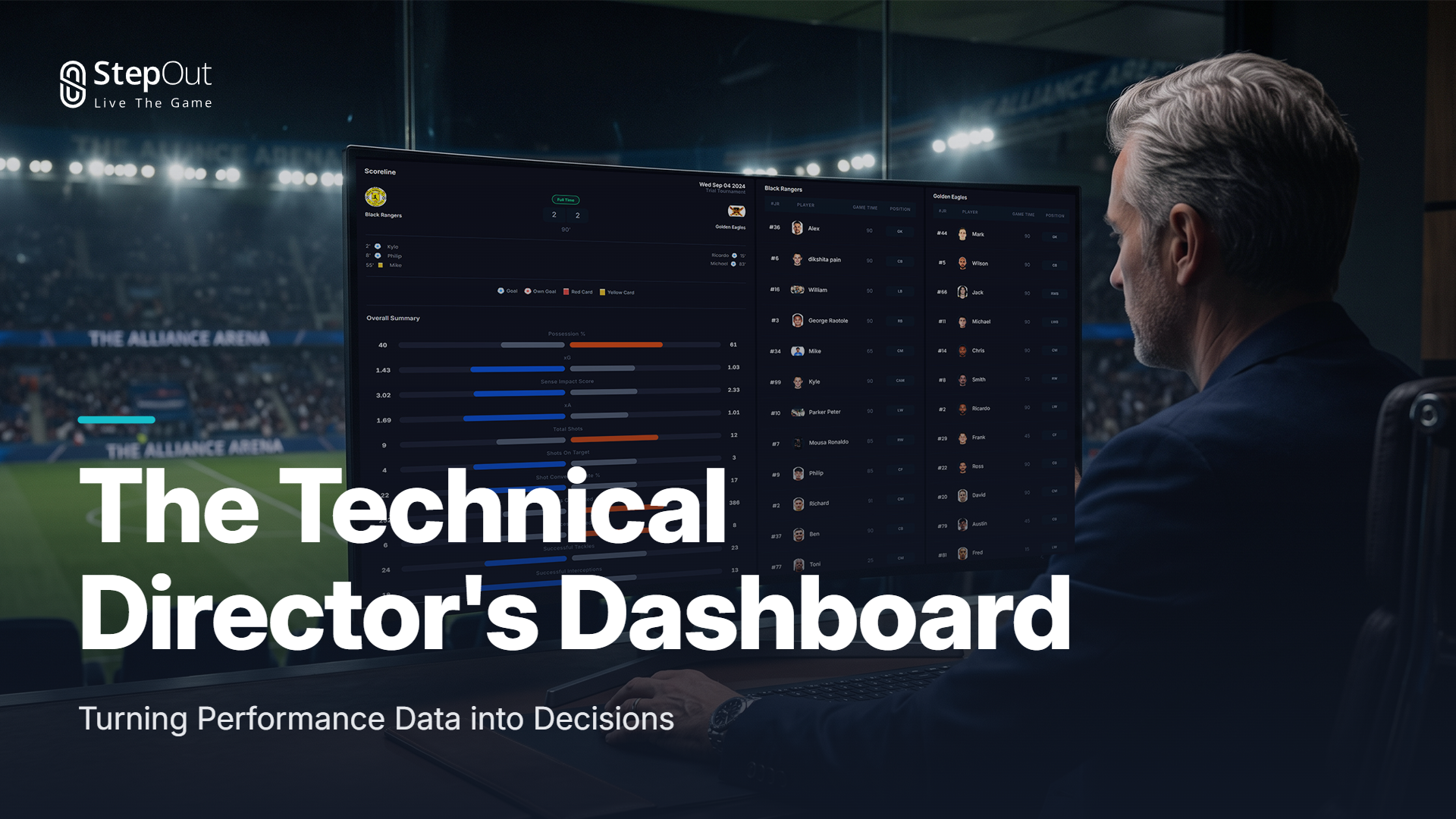
The Technical Director's Dashboard
Turning Performance Data into Decisions
What Should a Technical Director Actually See?
The first question when designing a performance dashboard is not which metrics to include. It is what the Technical Director needs to understand about the club.
A useful dashboard should provide enough detail to identify an issue without forcing the user to work through every available metric. The first view might show that chance creation has fallen over the last five matches, for example, but the value comes from being able to move from that trend into the underlying tactical and player information.
A club's football club performance dashboard should therefore bring several layers of performance together.
Team Performance
At the highest level, the Technical Director needs a clear view of how the team is performing against the club's expectations. Results will always matter, but they provide only one part of the picture.
Depending on the club's playing model, relevant indicators could include expected goals, shot quality, field position, possession progression, pressing activity, final-third entries, chance creation and defensive actions. The exact metrics will vary, but the purpose is the same: to establish whether the team's performances are moving towards the standards the club has set.
Tactical KPIs
If the club has defined principles around build-up, pressing, transitions or attacking structure, those principles need measurable indicators.
For example, a club that wants to build through the centre might monitor progression through central areas, passing networks and final-third entries. A team built around aggressive pressing could track pressing intensity, recoveries in advanced areas and how often pressure leads to possession regains.
Player Availability and Development
The Technical Director also needs visibility beyond team performance. Player availability, minutes, development trends and individual performance can reveal issues before they become larger squad problems.
A player's output may be declining gradually, for example, while their playing time remains consistent. That could prompt a closer review by the coaching or performance team. Similarly, a young player showing sustained improvement may deserve greater exposure to the first team.
Individual Player Reports
A club-wide dashboard or TMS (Total Management System) should also provide a route into individual reports. The Technical Director does not need every player report on the opening screen, but should be able to move from a squad-level trend to the players contributing to it.
This is where football performance analytics becomes particularly useful. Instead of simply ranking players, the club can track how individual performances are changing against their role, position, previous output or established benchmarks.
From Club KPIs to Individual Player Performance
A useful performance system should allow the Technical Director to move between different levels of the club without losing context.
A team-level dashboard might show that the side's progression through midfield has declined over six matches. That is useful, but it raises another question: is the problem collective, or is it being driven by particular players or situations? Individual player reports can help answer that.
A midfielder's progressive passing may have remained stable while his involvement in build-up has fallen. Another player's involvement may have increased, potentially changing the team's distribution patterns. Video can then show whether those changes are tactical, opposition-driven or related to individual performance.
This is where football performance tools become more valuable than simple statistical dashboards. The objective is to move from a number to an explanation.
StepOut's Match Overview, for example, brings together match-level information with player and tactical views. Its Network Analysis can show passing relationships and team dynamics, while Activity Maps and Vector Maps provide visual information about player actions, positioning and ball movement.
For a Technical Director, that creates a practical route from a squad-level observation into the detail behind it.
Connecting Training With Match Performance
Training is where the club attempts to develop the behaviours it wants to see in competition, which makes football training analysis an important part of the wider performance picture. If a club has identified a weakness in its pressing structure, for example, the Technical Director may want to know whether that issue is being addressed during training and whether the change is appearing in matches.
Suppose a team is working on recovering possession higher up the pitch. Training analysis can help coaches assess the behaviours being practised, while match analysis can show whether those behaviours are appearing under competitive pressure.
If the match KPIs remain unchanged over several weeks, that becomes useful information for the Technical Director. Perhaps the training intervention needs to change. Perhaps the team needs a different tactical approach. Perhaps the available players are not suited to the intended style.
The dashboard does not answer those questions by itself. It gives the Technical Director enough evidence to ask the right ones.
StepOut supports both match and training footage analysis, allowing clubs to upload footage from different sources and generate player and team performance information.
Putting Tactical KPIs Into Context
A KPI is only useful when the club knows what it is trying to measure. A team might have a strong possession percentage but still struggle to progress the ball. A forward might record a high number of shots while producing relatively modest chance quality. A defender might make a large number of tackles because the team's structure is consistently exposing him to defensive situations.
This is why football coaching analytics needs to go beyond reporting whether a number has gone up or down. The Technical Director needs to understand the relationship between the metric and the team's football model.
For a club focused on possession and controlled progression, relevant KPIs might include:
For a team that prioritises aggressive defending, the emphasis might shift towards:
The important point is that the tool should reflect the club's methodology. A generic collection of popular football metrics is unlikely to provide the same value as a smaller set of measures tied directly to how the club wants its teams to play.
- Progressive passes and carries
- Final-third entries
- Possession sequences
- Field position
- Passing networks
- Chance creation
- Pressing intensity
- Possession regains
- Defensive actions
- High turnovers
- Recovery locations
- Transition outcomes
Using Performance Data Across the Academy
For clubs with established academy pathways, one of the most important questions is whether players are developing towards the standards eventually expected at senior level. A football club performance dashboard can help create greater continuity between those environments.
The metrics used at U13 level will naturally differ from those used with senior professionals, and development should never be reduced to hitting a set of statistical targets. However, structured performance information can provide another reference point alongside coaching observation and player development plans.
The Technical Director might want to see whether:
This also creates a stronger connection between the academy and recruitment strategy. If the club consistently produces certain player profiles internally, recruitment can focus more deliberately on the qualities that are harder to develop or currently missing from the pathway.
StepOut's platform is designed for both professional clubs and youth academies, with performance benchmarks, player reports, video analysis and player development tools forming part of its wider offering.
- Players are progressing against position-specific benchmarks.
- Individual development trends are moving consistently over time.
- Academy teams are working towards similar tactical principles.
- Players are being exposed to the behaviours required at the next level.
- Promising players are showing measurable progression before entering first-team consideration.
From a Performance Trend to a Football Decision
Imagine a Technical Director notices that the team's chance creation has fallen steadily over six matches. The dashboard flags the trend, but the next step should not be an immediate tactical conclusion.
The Technical Director might look at the team's attacking KPIs, then examine individual player contributions. From there, video can show whether the team is reaching the same areas but making fewer final actions, or whether it is struggling to progress into those areas altogether.
The coaching staff may then have a specific problem to work on.
If the issue is linked to one position, the Technical Director may also begin considering squad depth or recruitment. If the same issue appears across the academy, it may point towards a development priority.
The value is created through the sequence:
That final stage is important. A decision should eventually return to the dashboard as a measurable outcome.
- Data identifies the change.
- The KPI defines the issue.
- The trend establishes whether it is persistent.
- Context explains what may be causing it.
- The football department decides what to do.
- Follow-up data shows whether it worked.
Why the Tool Needs More Than Numbers
A Technical Director's working day is already divided between meetings, recruitment, coaches, players, academy staff and club leadership. A dashboard that requires a specialist to interpret every screen is unlikely to become a practical part of that routine.
This is where football performance software and football performance platform design become important. The system needs to make complex information accessible without stripping away the context that makes the information useful.
A good football KPI dashboard should therefore answer three questions quickly:
For an executive audience, the view can be even more concise. A football executive dashboard might focus on club-wide trends, performance against agreed KPIs, player availability, academy progression and major areas requiring attention. The Technical Director can then move deeper into the underlying information when necessary.
- What is happening?
- Which team, player or department has changed?
- Why might it be happening?
- Which tactical, performance or contextual factors sit behind the change?
- What needs attention?
- Does the trend require further analysis, a coaching intervention, a player review or a longer-term strategic decision?
How StepOut Can Support the Technical Director's View
This is where StepOut's broader Total Management System (TMS) becomes relevant to the Technical Director's role.
StepOut is built around AI-driven analysis of match and training video, converting footage into structured player and team information. The platform tags actions and generates performance data, and produce more than 400 data points from a match.
For a Technical Director, the value is in being able to move between the different layers of performance rather than treating them as separate reports.
The Match Overview provides a wider view of the game, including player impact, tactical involvement and team relationships. Network Analysis can reveal passing structures and connections, while Activity Maps and Vector Maps provide additional context around player actions and positioning. Spotlight provides a pre-tagged video library, allowing staff to move quickly from analysis into the relevant match moments.
The Tactical Match Summary (TMS) adds another layer by generating tactical insights around game flow, player roles and team movement. For a Technical Director reviewing whether the team's playing principles are appearing consistently, this creates a useful bridge between performance information and tactical context.
At player level, the StepOut Player App gives players access to their own performance information, highlights and metrics, creating another connection between club-level oversight and individual development.
This broader structure is important because a Technical Director is rarely interested in a metric for its own sake. The question is what that metric means for the team, the player, the training environment or the longer-term direction of the club.
StepOut's approach brings those layers closer together: match footage provides the evidence, analytics helps structure it, tactical views add context and player-level tools make the information usable beyond the analyst's desk. The result is closer to a performance command centre than a traditional collection of post-match reports.
For a Technical Director, that is ultimately the purpose of the dashboard. It should make the club easier to understand. Not by reducing football to numbers, but by giving those responsible for the football operation a clearer way to see what is changing, investigate why it is changing and decide what should happen next.
Frequently Asked Questions
What should a Technical Director monitor?
A Technical Director should monitor team performance, tactical KPIs, player development, availability, training trends, academy progression and performance against the club's playing model.
What is football performance analytics?
Football performance analytics uses match, player and team data to identify performance trends, evaluate tactical behaviours and support coaching, recruitment and player development decisions.
How does training analysis support a Technical Director?
Training analysis shows whether behaviours being developed during training are appearing in matches, helping Technical Directors assess interventions and track whether performance trends are improving.
How can AI help with football performance analysis?
AI can automate video analysis, event tagging and data extraction, allowing clubs to process large amounts of footage faster and giving analysts more time for interpretation.