
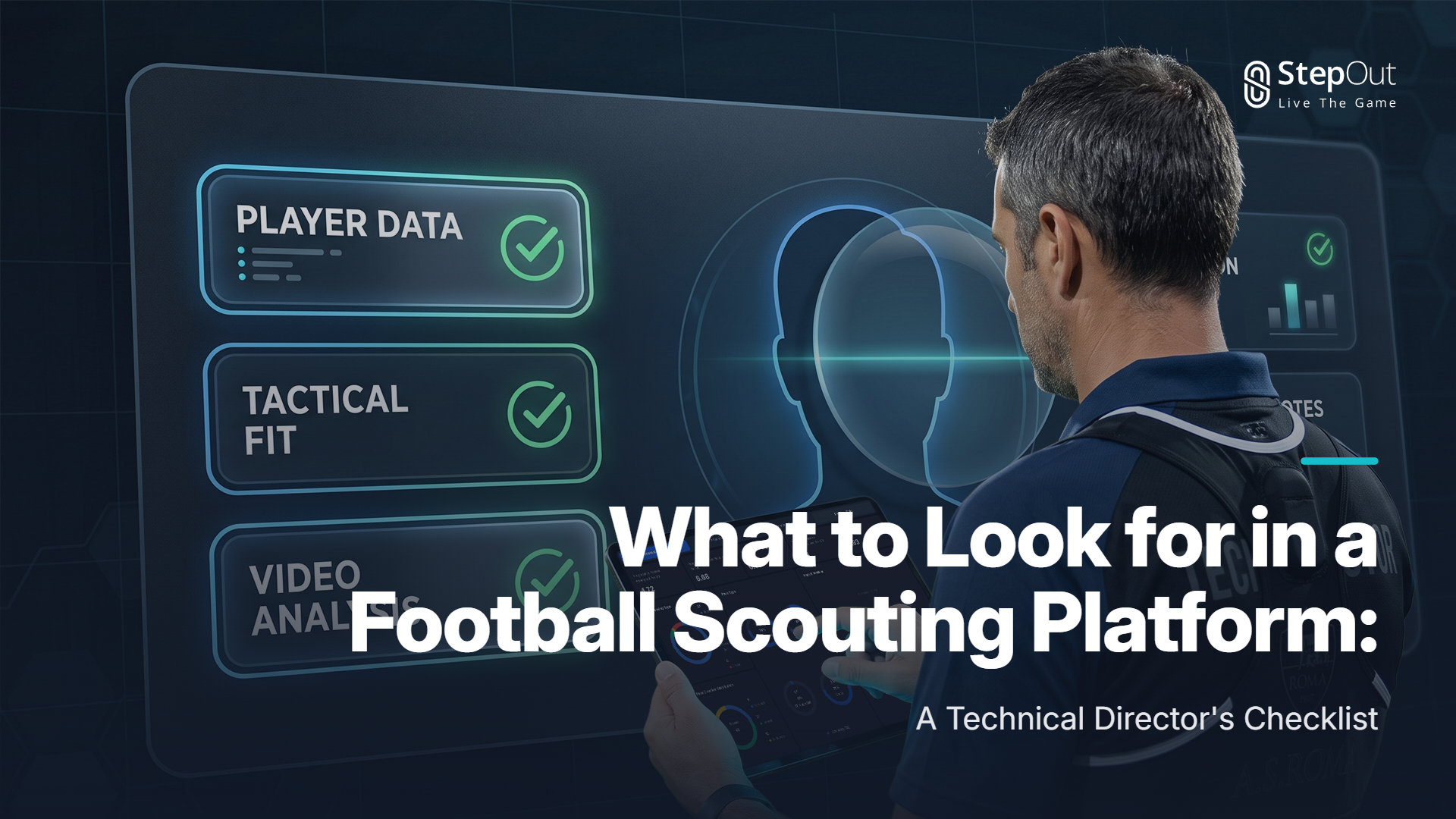
What to Look for in a Football Scouting Platform
A Technical Director's Checklist
Why the Evaluation Matters More Than the Demo
A scouting platform shapes what your staff can see, which in turn shapes who gets recruited. A tool that filters well for physical output but poorly for tactical fit will quietly push your scouts toward players who look good on paper and away from players who solve a specific system problem. That bias is invisible in a sales pitch and very visible later on.
The criteria below are the ones that hold up once the trial period ends and the daily grind starts. Each one maps to a real cost, in either wasted staff hours, missed players, or a contract that locks a club into the wrong tool for years.
Start With Data Depth
Every football scouting software provided will show you a large number of tracked metrics. The number matters less than what sits behind it. A centre-back who makes eight clearances against a team parked in a low block is doing different work than one making eight clearances against a high-press opponent creating transition chances. Platforms that report the first number without the second are measuring activity, not quality.
Before signing, ask to walk through these points using a match you already know well:
For a technical director building recruitment profiles around playing style and system fit, this distinction determines whether the data actually informs a signing or just decorates a report.
- Does the platform contextualise actions (pressure applied, space available, defensive shape) or only count them?
- Can it separate a player's output in and out of possession?
- Are the underlying definitions for each metric published and consistent across competitions?
- Does it flag data confidence or coverage gaps rather than presenting every number with equal certainty?
How the Platform Handles Video
The value of most football scouting tools comes from how tightly they link a stat to the clip that produced it, and how fast a scout can get to watch every relevant action of an interesting profile without scrubbing through ninety minutes of raw match footage.
Test the tagging speed and accuracy directly: upload a match your team already knows and check:
A platform that can't make those distinctions is asking your scouts to do that filtering manually, which defeats the point of the tool.
- How long it takes for tagged clips to appear after upload.
- How precisely the platform isolates the moment, not five seconds before or after the actual event.
- Whether clips can be filtered by phase of play, not just by action type.
Camera Dependency Decides Who You Can Actually Scout
Some platforms only process broadcast-quality footage from tracked competitions. That works fine if your recruitment pool sits entirely in leagues with existing camera infrastructure. It breaks down fast if any part of your scouting remit touches academy football, lower divisions, or markets where matches are filmed on a single sideline camera or a phone on a tripod.
Get an answer on:
A club recruiting across multiple continents or investing in grassroots pipelines needs a platform that turns inconsistent footage into usable data, not one that quietly narrows the talent pool to whatever's already broadcast-ready.
- Which footage formats and resolutions the platform accepts.
- Whether it processes single-camera or tactical-cam footage, not just broadcast feeds.
- How accuracy changes when footage quality drops.
- Whether there's a minimum camera specification the club would need to invest in.
Tactical Context Separates Software From Scouting
A good football scouting platform should tell you how a player fits a system, not just how a player performed in isolation. This matters most for players being scouted for a role they don't currently occupy in their own team.
Look specifically for:
- Passing network visualisations tied to the tactical setup a match was played in.
- Defensive shape analysis, not just individual defensive actions.
- Positional heat maps or activity fields that give insight into player role.
- The ability to compare a player's current role and suitability with other roles.
Usability for Your Staffs
The most sophisticated platform on the market delivers zero value if your head scout finds it confusing and quietly reverts to a personal spreadsheet after two weeks. Coaches and scouts working across multiple age groups and matches per week don't have time to learn a system built primarily for data scientists.
Involve the actual end users, scouts, analysts, and coaching staff, in any trial period, and watch:
A platform's information design (how clearly it presents a passing map, how intuitively it lets someone filter by position) is as important a criterion as its raw analytical capability.
- How long it takes someone with no data background to independently pull a player report.
- Whether the interface requires training documentation to navigate basic tasks.
- How the platform performs on mobile, since scouts are often in a stand or on a sideline, not at a desk.
- Whether staff adoption is still active after the first month, not just the first week.
Filtering and Recruitment Briefs
Recruitment work runs on specific, narrow criteria. Weak platforms let you filter by position and a couple of basic stats. Strong ones let you combine several layers into a single searchable brief.
Test whether the platform can build a brief that combines:
- Positional role and tactical system.
- Physical profile (age, height, dominant foot).
- Performance thresholds across specific metrics.
- Budget or contract-status parameters.
- The ability to save and rerun the player summary as new matches get processed.
Reporting for the Boardroom and Analysts
The person building the recruitment case and the person approving the budget are usually not the same person, and they don't need the same output. A platform that only exports raw data tables puts the burden of translation on your analysts every single time a signing needs sign-off.
Check whether the platform can generate a clean, presentation-ready report for ownership or a sporting director alongside the detailed analytical view your own staff work from. A tool that produces a client-facing summary report directly saves real hours across a recruitment cycle.
Contract Terms and Data Ownership
This is the part TDs sometimes leave to procurement, and it shouldn't be. What happens to years of scouting data if the club switches service provider later depends entirely on the terms signed on day one.
Before signing, get clear answers to:
- Who owns the historical data, tagged clips, and scouting notes once the contract ends.
- Whether that data and video are exportable in a usable format.
- How pricing scales if the platform expands from first team only to a full academy or pathway rollout.
- Whether academy or youth-level access is priced as a separate tier, and what that tier costs.
Putting the Checklist to Work
Run every serious vendor through the same structured trial: real footage from your own league, your own scouts building an actual recruitment brief, and a report generated for someone outside the analytics department. The platforms that hold up under that test, rather than a curated demo, are the ones worth a multi-year commitment.
StepOut works with technical directors and recruitment teams across the globe, combining AI-driven video tagging with tactical and positional analysis built for exactly this kind of evaluation. If you want to run your own footage through the platform before deciding, get in touch with our team.
Frequently Asked Questions
What's the difference between football scouting software and a full scouting platform?
Football scouting software typically refers to a single tool, often video tagging or a stats database. A scouting platform combines video, data, tactical analysis, and reporting into one connected system, so a technical director doesn't need to cross-reference separate tools to build a full recruitment picture.
Do football scouting tools work with non-broadcast footage?
It depends entirely on the vendor. Some tools require broadcast-quality footage from tracked competitions, while others like StepOut are built to process single-camera footage from lower leagues and academy matches. This is a critical question to ask before signing, especially for clubs scouting outside major broadcast markets.
Can a scouting platform replace human scouts?
No. A scouting platform narrows the pool and speeds up video review, but judgment on character, adaptability, and fit still comes from human scouts and coaches watching players in person and on tape.
What should a technical director prioritise if budget is limited?
Video-to-data linking and usability tend to deliver the fastest return, since they directly reduce the hours scouts spend manually reviewing footage. Tactical modelling and boardroom reporting matter more once a club is running a high volume of recruitment cases across multiple positions and leagues.