
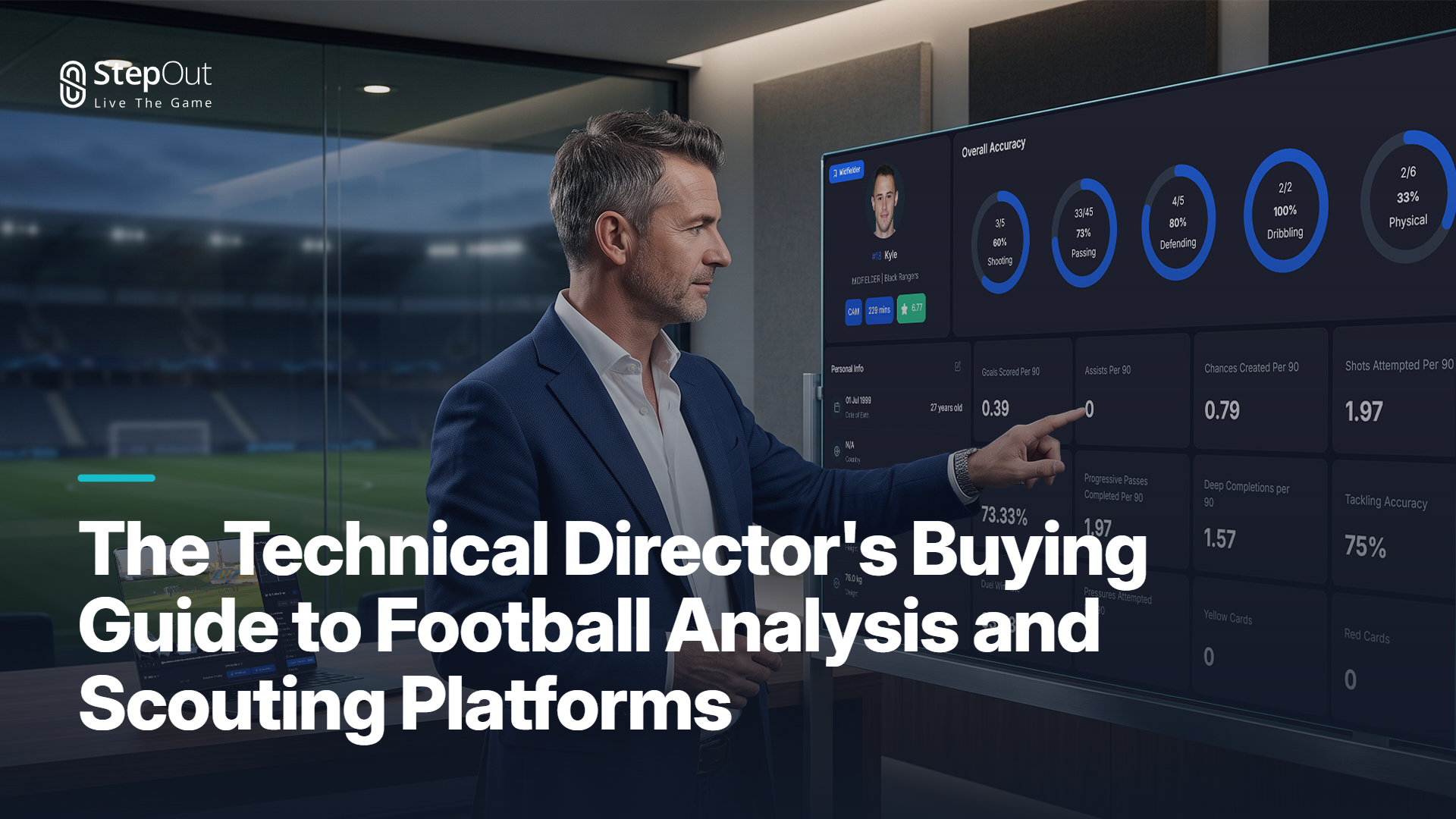
The Technical Director's Buying Guide to Football Analysis and Scouting Platforms
A Practical Selection Framework
Why is Football Analytics So Important in Modern Football?
Football has always involved judgement, experience and instinct. What has changed is the amount of information available to support those decisions. Clubs now analyse thousands of actions across matches, players and competitions. Coaches can study tactical patterns, recruitment teams can benchmark potential targets, and performance staff can track player development over time.
For a modern football department, analytics can contribute to several areas:
The real advantage comes when data can be connected to match footage, tactical context and the knowledge of coaches and scouts.
That is why modern football analytics software is moving beyond basic statistics. The most useful football analytics platforms bring video, performance data, scouting and player development into a connected workflow, helping clubs move from what happened to why it happened and, ultimately, what to do next.
- Tactical analysis: Identify patterns in possession, pressing, defensive organisation and chance creation.
- Player performance: Assess individual actions and trends using objective performance data alongside video.
- Scouting and recruitment: Compare potential signings with existing players and role-specific requirements.
- Player development: Track progress over time and identify areas for improvement.
- Opposition analysis: Understand how upcoming opponents create chances, defend and respond to different situations.
- Decision-making: Give coaches, scouts and Technical Directors a shared evidence base when evaluating players and teams.
Why Choosing the Right Platform Matters
Deciding to go with any football technology affects far more than the analysis department.
The same system may support:
A strong football analytics platform can give coaches, analysts, scouts and sporting staff access to the same underlying information. A fragmented setup creates more work around exports, spreadsheets, duplicate data and repeated analysis.
The best system should therefore fit the way the football department already works, while creating a smoother path from information to action.
- Match and opposition analysis
- Player performance analysis
- Recruitment and scouting
- Player benchmarking
- Academy development
- Coaching feedback
- Technical decision-making
Start With Your Football Department’s Workflow
A common mistake when comparing football analytics software is starting with the feature list.
Every platform can showcase dashboards, video analysis, player profiles and statistics. The more useful question is how those features work together in a real football environment.
Start by mapping the current workflow.
Ask:
Who uploads the footage? Who tags it? How long does it take before the coaching staff can review the key moments?
How does the analyst move from raw footage to trends, tactical patterns and a matchday report?
Can a scout compare an external player with the club’s existing squad using the same metrics and video evidence?
Can coaches track a player’s progress over time and connect performance data with video and feedback?
Count the logins, exports, spreadsheets and manual steps required to move from a match to necessary insights.
These gaps give you a much more useful evaluation framework than a generic feature comparison.
- How does match footage become analysis?
- How is opposition analysis prepared?
- How does recruitment use performance data?
- Where does player development information live?
- How many tools are involved?
10 Things to Look for in a Football Analytics Platform
Connected Data Across Video, Analysis and Scouting
A platform can have plenty of features and still create a fragmented workflow. Start by looking at how the system handles player identities, match data and metrics across different areas of the product.
Can an analyst move from a video clip to the underlying performance data?
Can a scout move from a player comparison to the relevant match footage?
Can staff compare players across competitions using consistent definitions and datasets?
A truly connected football analytics platform should allow these actions within the same workflow. This is particularly important when the platform supports several departments. Coaches, analysts and scouts should be able to work from the same player and match information.
Speed From Video Upload to Insight
Football video analysis has traditionally involved a significant amount of manual work. Analysts may spend hours tagging events before the footage becomes useful for tactical review, performance analysis or recruitment.
Modern football video analysis software can automate much of this process through AI and computer vision. Match footage can be converted into structured events and searchable information such as passes, tackles, shots and positional data.
During evaluation, ask practical questions:
The key metric is time to insight. A report delivered quickly enough to influence a training session, recruitment discussion, or match preparation has far greater value than information that arrives days later.
- How long does it take from video upload to the first usable report?
- What footage quality is required?
- Which camera angles are supported?
- Can existing broadcast or tactical footage be used?
- What happens with single-camera footage from academy matches?
- How much manual input is still required from the analyst?
A Scouting Workflow Built Around Recruitment
A football scouting platform should help scouts answer recruitment questions. Player profiles and statistics are useful starting points, but recruitment decisions usually require a deeper comparison.
A good scouting workflow should allow staff to:
A statistic becomes much more useful when a scout can immediately review the actions behind it. A player’s progressive passing numbers, pressing activity or final-third involvement can then be assessed alongside the actual footage. That combination brings data and traditional scouting closer together.
- Benchmark a transfer target against the current squad
- Compare players across leagues and competitions
- Filter players using positional or tactical requirements
- Combine statistical data with video evidence
- Build shortlists that coaches and sporting staff can easily understand
Tactical and Positional Analysis
Event counts provide useful information, but they only tell part of the story. A serious football analysis platform should help staff understand how actions occur within the team structure.
Depending on the club’s requirements, this can include:
This distinction matters because football analysis is ultimately about context. Knowing that a player completed ten progressive passes is useful. Seeing where those passes happened, how they affected progression and how they fit into the team’s attacking structure provides a much richer picture.
- Passing networks
- Positional heatmaps
- Team shape
- Player positioning
- Pressing behaviour
- Player interactions
- Territorial control
- Ball and player movement
Tools That Reach the Player
Analysis becomes more valuable when it reaches the people who need to act on it. For coaches, that may mean sharing clips with players after a match. For an academy, it may involve tracking development over several months. For an individual player, it may mean understanding how their current performance compares with a role benchmark.
Look for features such as:
This helps move performance analysis beyond the analyst’s workspace and into the player development process.
- Individual performance reports
- Player benchmarking
- Attribute scores
- Coach feedback
- Video clips linked to specific actions
- Player-facing dashboards or mobile access
Data Accuracy and Trust
Automation only works when staff trust the output. Ask how automated event detection is validated, how accuracy is measured and how the system handles inconsistencies in footage.
A coach who regularly finds errors in event data will naturally rely more heavily on their own observations. A scout who questions the underlying dataset will spend additional time validating every comparison. Data quality therefore deserves the same attention as the number of features available.
Compatibility With Your Existing Technology
Most clubs already have a technology ecosystem in place. That might include video providers, GPS systems, physical performance software, medical systems, club databases and recruitment tools.
Before signing a new platform, understand how it fits into that ecosystem.
Ask:
The goal is a practical technology stack that supports the football department’s work.
- Which video sources can be connected?
- Can existing footage be imported?
- Can data be exported when required?
- Can the platform work alongside existing systems?
- What integrations are available?
- What happens to your existing workflows during implementation?
Club-Wide Scalability
A football analytics platform should make sense beyond the first team. Technical Directors increasingly need technology that can support the full player pathway, from academy development through senior football and recruitment.
Consider whether the platform can serve:
A platform that can be used across the club creates more opportunities to standardise processes, share information and build a common performance language.
- Academy teams
- Development squads
- First-team analysis
- Recruitment
- Coaching staff
- Player development
Onboarding, Support and Product Development
Technology adoption often comes down to the experience after the contract is signed.
Ask what implementation actually involves.
A football department operates around fixtures, training schedules and recruitment deadlines. Support needs to work within that reality. The product roadmap also matters. Football technology is evolving quickly, particularly across AI-powered video analysis, automated tagging and performance analytics.
- How much training will analysts receive?
- How quickly can coaches and scouts begin using the system?
- Who handles support during the season?
- How frequently is the platform updated?
Data Ownership and Security
Data governance belongs in the buying conversation from the beginning.
Before signing a contract, confirm:
These questions are especially important when the platform becomes part of the club’s long-term football operations.
- Who owns uploaded match footage?
- Who owns player performance data?
- Where is the information stored?
- How is it protected?
- What happens to the data when the contract ends?
- How can the club retrieve its information?
Football Analytics Platform Checklist
| Evaluation area | Question to ask | Why it matters |
|---|---|---|
| Data integration | Do video, scouting and analytics use the same player and data structure? | Creates a connected workflow |
| Video automation | How quickly does uploaded footage become usable analysis? | Reduces analyst workload |
| Scouting | Can scouts benchmark targets against the current squad? | Supports recruitment decisions |
| Video evidence | Can statistics be linked directly to match footage? | Adds context to performance data |
| Tactical analysis | Does the platform provide positional and team-level analysis? | Supports deeper football analysis |
| Player development | Can players and coaches access individual feedback? | Connects analysis with development |
| Accuracy | How is automated tagging validated? | Builds trust in the data |
| Integration | Can the platform work with existing technology? | Makes implementation easier |
| Scalability | Can it support academy and first-team workflows? | Increases long-term value |
| Support | What does onboarding and ongoing support look like? | Drives adoption |
| Data ownership | Who owns the club’s footage and data? | Protects the club’s information |
Where StepOut Fits in Among the Best Football Analytics Platforms
StepOut brings match analysis, scouting and player development into one football-focused platform, helping clubs spend less time managing separate tools and more time working with the information they already collect.
At the centre of the platform is StepOut’s Total Management System (TMS), which turns match footage into structured performance information. Once a game is uploaded, AI and machine learning automatically identify key events, giving coaches and analysts a ready-to-use library of match actions. The TMS also brings together tactical, positional and player interaction data, helping you understand not only what happened during a match, but how and where it happened.
This same performance information can support recruitment through StepOut’s Scouting Portal. Scouts can use player data and match evidence to assess potential targets, compare performances and add another layer of evidence to the traditional scouting process. Making the search and evaluation process more efficient in the process.
StepOut also connects analysis with player development. The Athlete App gives players access to their performance information, video actions, player profile, achievements and coach feedback. The Individual Development Plan gives coaches a structured way to set objectives, review progress across matches and combine performance data with their own evaluations.
For a Technical Director, this creates a more connected football operation. Analysis can inform recruitment, performance data can support player development, and the same information can be followed across teams and age groups.
Questions to Ask During a Football Scouting and Analysis Platform Demo
A polished product demo can make almost any platform look impressive. The better approach is to make the vendor walk through a real football workflow.
Ask them:
This reveals how well the different parts of the platform connect.
This gives you a practical measure of speed and automation.
This tests the recruitment workflow using a realistic scenario.
This reveals how well the technology supports player development.
This tests data ownership and portability.
A useful demo should feel like a football workflow rather than a tour of individual features.
- Show us the complete process from match upload to scouting shortlist.
- How long does a 90-minute match take from upload to a coach-ready report?
- Show us how a scout would compare a transfer target with three players already in our squad.
- What would an academy player see after opening the platform following a match?
- What happens to our footage and data if we leave the platform?
Frequently Asked Questions
What is football analytics software?
Football analytics software is technology used to collect, process and present football performance data. Depending on the product, this can include match statistics, video analysis, player performance metrics, tactical analysis and visual reporting.
What is the difference between football analytics software and a football analytics platform?
Football analytics software can refer to an individual tool built around a particular analysis function, such as video tagging or statistical reporting. A football analytics platform usually covers a broader workflow, connecting areas such as match analysis, scouting, performance data and player development within one system.
Do smaller clubs and academies need a football analytics platform?
The value can be particularly strong for clubs with smaller analysis teams. Automation can reduce manual tagging and reporting work, while a shared platform can give coaches, scouts and academy staff access to the same performance information. The important factor is choosing a system that matches the club’s budget, staffing and workflow.
What should a Technical Director prioritise when choosing a football analytics platform?
Prioritise workflow integration, data quality, usability and adoption. A platform with an impressive feature list still has limited value when staff have to move between several disconnected systems to complete a task. A connected workflow from video analysis through to performance review, recruitment and player development is usually the stronger foundation.