

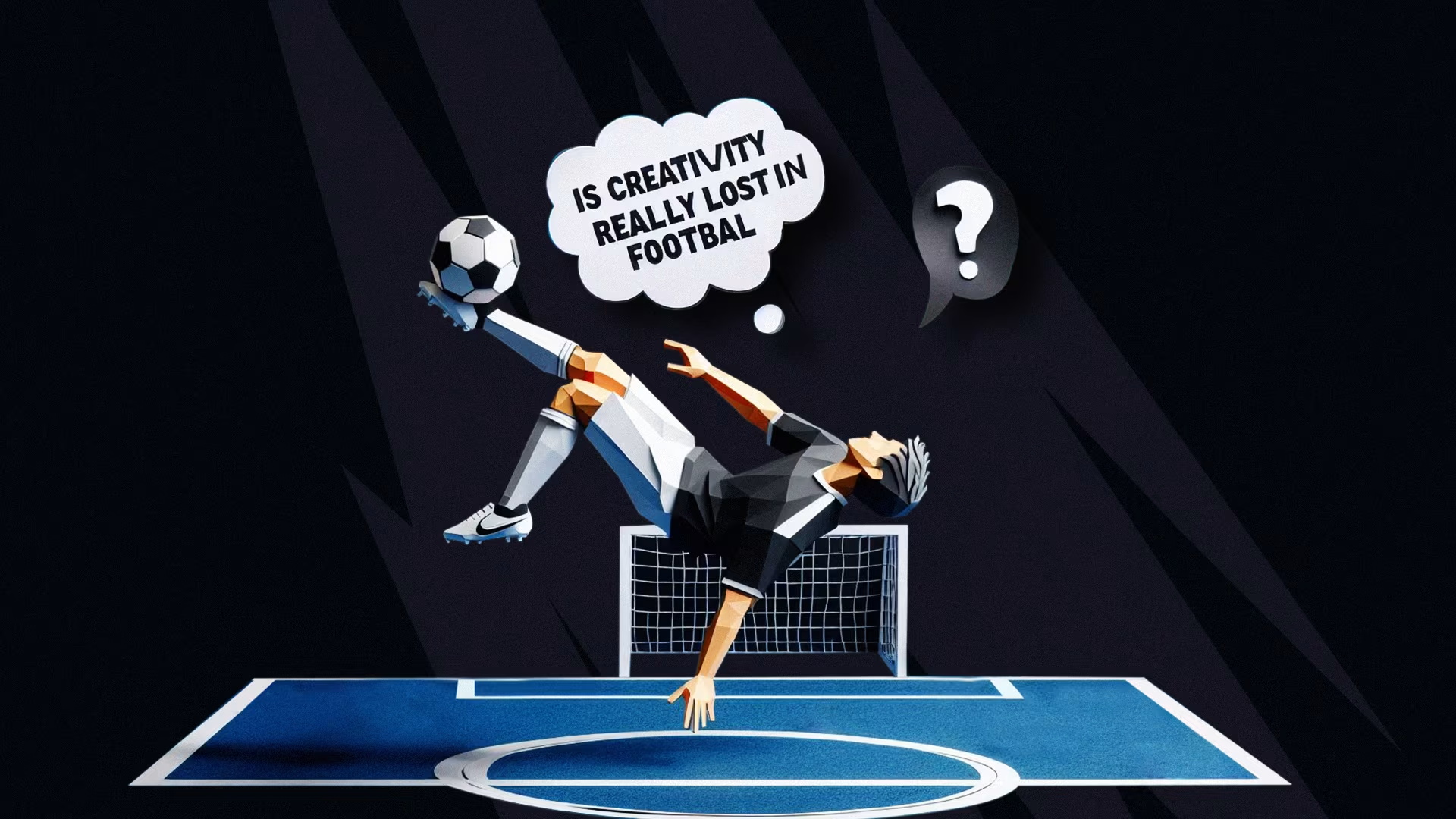
Is Creativity Really Lost in Football?
The Data Tells a Different Story
There’s a lot of talk about how football has lost its creative flair. Fans reminisce about the golden days of Messi, Maradona, and Ronaldo—when individuality and solo brilliance were at the heart of the game. But when we dig into the data, a different story emerges. Today’s players are, in fact, far ahead of where Messi and Ronaldo were at the same age.
It’s not that creativity has been lost—it’s evolved, along with the nature of the game.
Players Today Are More Skilled
—And the Data Proves It
Let’s look at the raw numbers. Take Messi’s 2009 season when he was 22. He averaged 1.7 dribbles per match and completed about 81% of his passes. By comparison, Bukayo Saka (aged 22 in 2024) averages over 2 dribbles per match and completes about 85% of his passes. Similarly, data from Palmer shows that he averages around 1.5 dribbles per game, which is on par with Messi at the same age, but Palmer also completes 87% of his passes—highlighting how modern players are more efficient in tight spaces.
When comparing goals, Palmer and Messi have similar outputs at their peak youth years, but Palmer's defensive contributions far exceed Messi's at a similar age, with an average of 1.7 tackles per game compared to Messi’s 0.5 tackles. This speaks to the versatility and adaptability required of today’s players.
The Role of the Number 10 Has Evolved
In the 90s and early 2000s, the number 10—think Zidane or Riquelme—was a free spirit, responsible almost exclusively for offensive creativity. They weren’t expected to press or defend much. But fast forward to 2024, and the role has changed completely.
Today’s number 10s, like Bruno Fernandes or Martin Ødegaard, are hybrid players. Fernandes, for example, completes 1.3 key passes per game but also makes an average of 1.7 tackles per match—something unheard of for traditional playmakers. The result? The modern number 10 is no longer just about flair but about enhancing the team’s overall tactical structure. The data reinforces this, showing that players like Palmer make about 2.3 key passes per game, all while contributing defensively.
The Shift from Individuality to Team Play
So, why does it feel like football has become less individualistic? The answer lies in the tactical shift towards collective, high-press systems that prioritize team play over individual expression. In a system like Pep Guardiola’s Manchester City or Jurgen Klopp’s Liverpool, every player—regardless of position—needs to contribute to the overall game plan. This has made football more about executing a fluid strategy than relying on one player to create moments of magic.
In terms of goal-scoring, consider this: the average number of passes before a goal in top European leagues has risen by over 35% in the past 10 years, according to Opta Sports. Teams now favor intricate build-up play, with multiple players involved in orchestrating the attack, rather than relying on a single dribbler or playmaker.
Why Team Play Feels Less Flashy
—But Is More Effective
It’s easy to feel like the game has become "less exciting" because we aren’t seeing the same level of solo dribbles or wonder goals from one individual. But in reality, team play has reached new heights. For example, Kevin De Bruyne currently averages 20 assists per season—far more than many past attacking midfielders—because he is working within a well-oiled system where every pass, movement, and touch is finely tuned.
At the same time, data shows that overall goals per game in top leagues like the Premier League and La Liga have actually increased by about 10% in the last decade. Teams score more goals now, not because of individual brilliance, but because of strategic, collective gameplay.
The Data Doesn’t Lie
When we ran a detailed analysis of young players in elite leagues, we found that today’s 21- to 23-year-olds are more versatile, well-rounded, and tactically aware than ever before. The emphasis has shifted from a reliance on individual brilliance to building cohesive, flexible teams.
For instance, Palmer’s ability to both create (averaging 2 assists per game) and defend (with 1.5 interceptions per game) shows how the modern footballer is expected to be involved in all phases of the game, while Messi at the same age had a more attack-centric role. Similarly, forwards like Erling Haaland are far more involved in pressing and off-the-ball movement compared to strikers from earlier generations.
Why This Matters for Football’s Future
The evolution in football’s tactical landscape is shaping the next generation of stars. Clubs now build teams around flexible systems rather than one marquee player. With more sophisticated data analytics available to clubs, the gap between “good” and “great” players is getting narrower, meaning every player is held to a higher standard.
So, while it may seem like the individual magic of Messi or Ronaldo is fading, the overall quality and intelligence of the game are at an all-time high. This shift is laying the foundation for a more dynamic, team-oriented future in football.
Football’s Flair Is Evolving, Not Disappearing
The idea that football has lost its creative flair is largely a matter of perception. While we may not see as many solo runs or individual dribbles, the game has reached unprecedented levels of tactical complexity and team efficiency. The next generation of players, equipped with data-driven training and an all-encompassing approach to the game, will redefine what creativity looks like on the pitch.
The game hasn’t lost its magic—it’s simply evolved into something far more complete.