

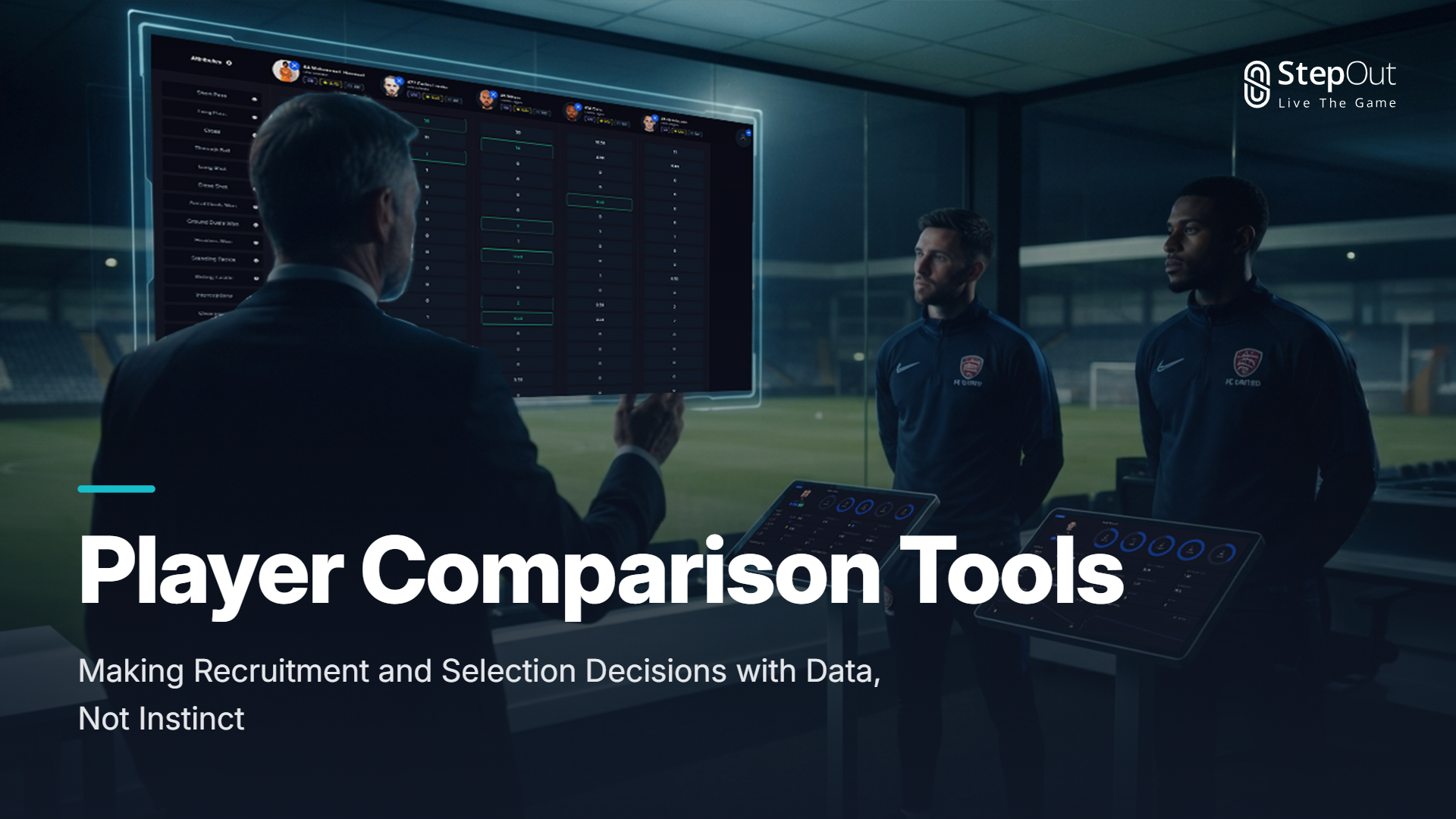
Making Recruitment and Selection Decisions with Data, Not Instinct
Player Comparison Tools
Why Clubs Rely on Data for Player Comparison
Scouting experience remains central to soccer decision-making, but comparing several players consistently becomes difficult when the process depends heavily on individual observations. Different scouts may focus on different qualities, while a limited number of viewed matches can make it difficult to establish whether a particular performance represents a player's usual level.
A detailed comparison can reveal differences between players that are difficult to establish through observation alone. Two midfielders might appear similar during a match, while their progressive passing, ball carrying, recoveries and involvement in advanced areas reveal distinctly different profiles. The same applies to defenders, forwards and goalkeepers, where role-specific performance indicators can expose strengths that traditional statistics often overlook.
For owners and Technical Directors, data also creates greater transparency around major recruitment decisions. When a club commits substantial resources to a player, being able to demonstrate how the player was evaluated and why the profile was considered suitable adds discipline to the recruitment process.
The purpose of data remains closely connected to soccer judgement. A comparison tool should give decision-makers better evidence while leaving room for scouting expertise, tactical understanding and knowledge of the player.
What Should a Meaningful Player Comparison Tool Measure?
A recruitment team evaluating two potential midfielders may need to understand progression, chance creation, defensive contribution and ability to operate within a particular playing model. A coach selecting between those same players may place greater emphasis on their current form, tactical suitability and performance against the next opponent.
The tool should therefore allow staff to compare players across the areas that matter to their specific roles. For attacking players, this could involve xG, xA, progressive actions, penalty-area involvement and chance creation. Midfield comparisons may place greater emphasis on progressive passes, progressive carries, recoveries, defensive actions and involvement in build-up play. Defensive comparisons can include interceptions, defensive actions, duels, progression and positioning.
A strong soccer player analysis process can also incorporate visual information, including activity maps and vector-based representations, to show where players operate and how their actions differ across phases of the game.
Relevance of Role and Playing Style
Position provides a useful starting point for comparison, while role provides considerably more context. Two full-backs may both occupy the same position but have very different responsibilities. One could be asked to provide width and progress possession aggressively, while another may stay deeper to protect against counter-attacks. Comparing their total passes or assists without considering those instructions could produce a misleading conclusion.
The same applies to midfielders. A deep-lying playmaker may contribute through progressive passing and build-up involvement, while a box-to-box midfielder may generate greater value through ball carrying, recoveries and final-third activity.
Player performance analysis should account for those differences. The comparison should reflect what the player is being asked to do and how successfully they execute those responsibilities.
Role-based comparison also helps clubs identify complementary profiles. A recruitment team may not need another player who replicates an existing squad member. It may require a player who provides qualities that the current squad lacks.
Context and Benchmarking Change the Picture
Performance data becomes more useful when the circumstances around it are visible. Players operate within different teams, leagues, tactical systems and levels of competition. A midfielder playing in a dominant possession team may have more opportunities to progress the ball than a midfielder operating in a side that spends long periods defending.
Playing time also needs consideration. Per-90 metrics can help compare players with different minutes, while percentile rankings and positional benchmarks can provide a clearer understanding of where an individual's output sits within a relevant player group.
League and competition context can also influence interpretation. Recruitment teams comparing players from different markets need to understand the environment in which the numbers were produced.
A comparison tool should therefore provide enough context to prevent isolated statistics from becoming the basis for a major decision. Data can identify the difference between two players, while video and tactical information can help explain why that difference exists.
Using Player Comparison for Recruitment
Recruitment departments regularly face situations where several players appear capable of filling the same position. The challenge is establishing which candidate best matches the club's soccer requirements and offers an appropriate level of risk for the investment involved.
Player comparison can bring structure to that process by placing shortlisted candidates against consistent performance criteria. A Technical Director might compare two centre-backs on their defensive actions, aerial performance, progression and ability to contribute to build-up play. A recruitment team assessing forwards could examine xG, chance creation, progressive actions and penalty-area involvement alongside video evidence.
The comparison can also support wider market exploration. Once a club understands the performance characteristics of a desired profile, those characteristics can be used to identify alternatives across different competitions and markets.
This gives recruitment teams a stronger basis for evaluating whether a player fits the squad before discussions progress towards a transfer fee, contract and long-term commitment.
Using Player Comparison for Team Selection
Player comparison has an equally important role once recruitment ends and the squad is established. Coaches frequently have to choose between players with overlapping strengths but different profiles. The better selection can depend on the opponent, tactical approach and specific requirements of the match.
A midfielder who offers stronger progression may be suited to a match where the team expects to dominate possession. Another player with stronger defensive numbers and transition contribution could be more appropriate against an opponent expected to attack quickly.
Comparison tools can help coaches examine those differences systematically. Current performance, role-specific metrics, tactical behaviour and video evidence can be considered together when deciding who starts, who sits on the bench and which player may provide the most useful option during the match.
Over a longer period, these comparisons can also contribute to squad management by showing changes in player performance and helping staff monitor whether individuals are developing in line with expectations.
What to Consider When Choosing Player Comparison Tools
A club’s decision-makers evaluating comparison technology should look beyond the number of metrics or features included in a platform. The important consideration is whether the tool can support the decisions the club actually needs to make.
- Data depth should allow staff to investigate player contribution beyond basic goals, assists and passing statistics, with advanced indicators relevant to different positions and roles.
- Role-based analysis should make it possible to compare players according to their tactical responsibilities rather than treating every player in the same position as identical.
- Benchmarking and context should provide appropriate reference groups, allowing staff to understand whether a player's output is strong relative to comparable players and competitions.
- Video integration should connect statistical findings with the actions that produced them. When an analyst identifies a meaningful difference, they should be able to investigate the corresponding match footage.
- Visualisation should make complex information easier to interpret through tools such as activity maps, positional information and action-based visuals.
- Usability also matters. A platform may contain sophisticated analysis, but its value decreases if coaches, scouts and decision-makers struggle to access or interpret the information during recruitment meetings or match preparation.
Core Features of an Effective Comparison Tool
An effective tool should provide side-by-side comparison across selected performance metrics, allowing staff to examine multiple players without manually compiling information from separate sources.
Advanced player data should cover the performance areas relevant to different roles, while benchmarking should help place those numbers within an appropriate positional and competitive context. Customisable comparisons are particularly useful because the criteria for evaluating a goalkeeper will differ significantly from those used for a winger or central midfielder.
Video should form part of the same workflow. Statistical information can highlight a difference, while footage allows analysts to investigate the actions, positioning and decisions behind it. Visual tools can add another layer by showing how and where those actions occur during matches.
Reporting is equally important when multiple departments are involved. Recruitment staff may need detailed player analysis, while a Technical Director may require a concise comparison for a decision meeting. Coaches may need information focused specifically on the tactical requirements of an upcoming fixture.
How StepOut Supports Player Comparison
StepOut combines player data, match analysis, video and visualisation to support detailed player performance analysis. Its platform provides player-specific performance information and reports, allowing clubs to examine individual contributions alongside the underlying match footage.
StepOut’s visual analysis capabilities add spatial context to the comparison process. Activity Maps and Vector Maps can help analysts understand where players operate and how their actions develop across different phases of a match.
The TMS also offers SenseVS, a dedicated side-by-side comparison feature that allows users to evaluate multiple players next to each other. Analysts can examine differences in performance, positioning and tactical behaviour while working alongside other visual information such as Activity Maps and Vector visuals.
SenseVS forms part of a broader comparison workflow rather than replacing the wider analysis process. Player data, performance reports, video and visualisation can be brought together to move from a statistical difference towards a more complete understanding of the player.
For recruitment teams, this can support the evaluation of shortlisted targets and provide a clearer evidence base before a transfer decision. For coaches and managers, the same capabilities can help compare selection options against the tactical demands of an upcoming match.
A useful comparison tool ultimately gives different departments a shared view of player performance. The scout can investigate the evidence, the analyst can examine the detail, the coach can assess tactical suitability, and the Technical Director can bring those perspectives into a wider sporting decision.
Frequently Asked Questions
What is player comparison in soccer?
Player comparison is the process of evaluating two or more players against relevant performance metrics, roles, tactical responsibilities and contextual benchmarks. Clubs use it to support recruitment, selection, squad planning and player development.
How does soccer player analysis help recruitment teams?
Soccer player analysis provides detailed information about a player's strengths, weaknesses, role and performance. Comparing several candidates can help recruitment teams establish which profile best matches the club's tactical and squad requirements.
Why should players be compared by role?
Players in the same position can have very different tactical responsibilities. Role-based comparison accounts for those differences and allows clubs to assess whether a player's performance matches the specific requirements of the position within their playing model.
What should an ideal player comparison tool include?
An effective tool should combine detailed player data, role-based metrics, benchmarking, contextual analysis, video integration, visualisations, side-by-side comparisons and reporting. These capabilities allow clubs to use the same analytical foundation across recruitment and first-team selection.