

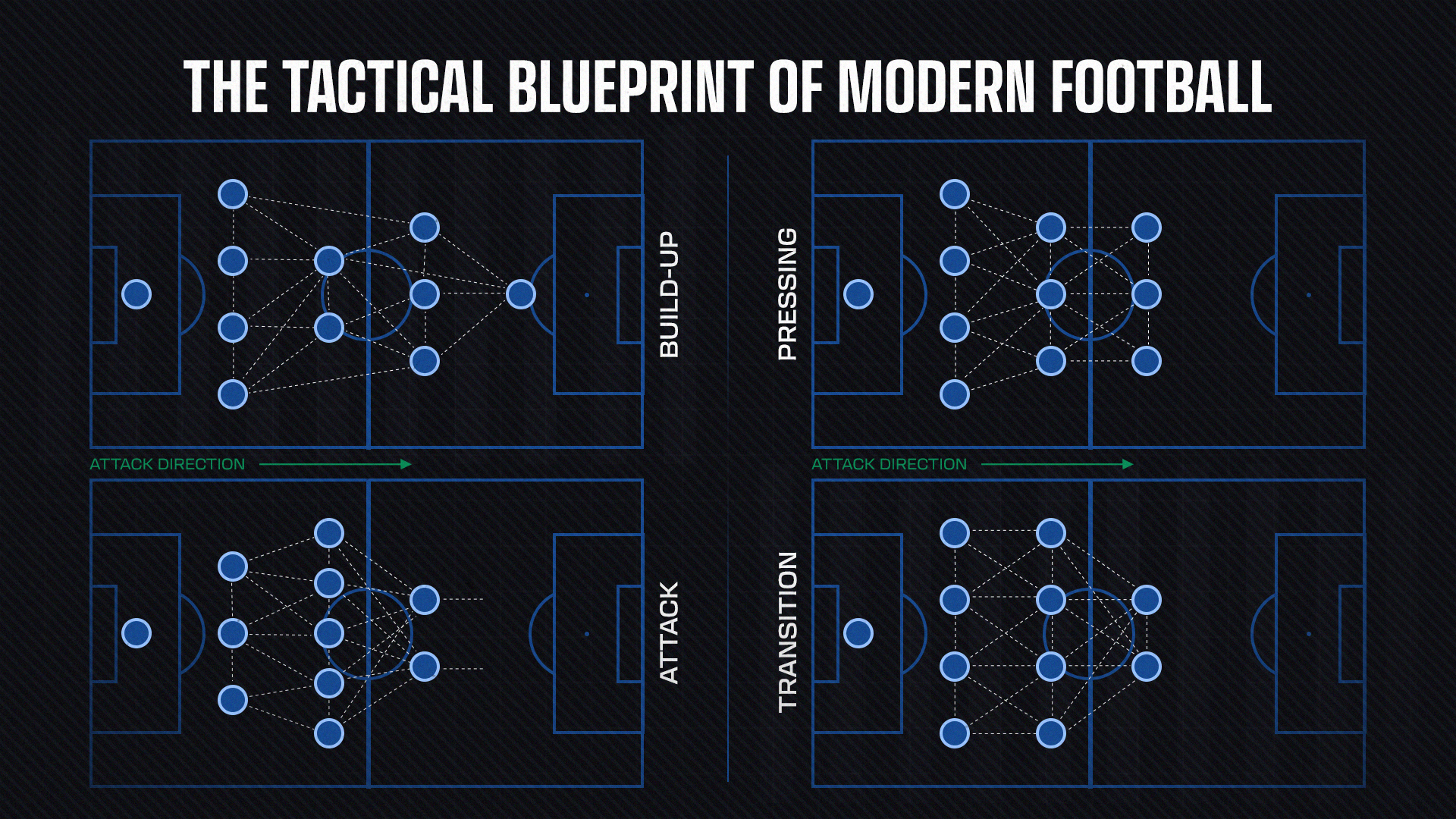
The Tactical Blueprint of Modern Football
How elite formations evolve across phases
4-2-3-1: The Modern Default
The 4-2-3-1 evolved as a smarter extension of 4-4-2, adapting to the demands of possession football. With a back four, a double pivot, three advanced midfielders, and a lone striker, it provides balance between stability and creativity. In possession, the double pivot secures build-up and allows full-backs to advance, while the number 10 operates between the lines to create overloads. Wide players often drift inside to combine in half-spaces, supporting the striker and increasing presence in the box.
Out of possession, the structure naturally collapses into a compact 4-4-1-1 or 4-5-1, offering strong central protection. However, the system can isolate the striker if support is delayed, and it often becomes heavily dependent on the creative influence of the number 10. Under José Mourinho at Real Madrid CF, the formation demonstrated how defensive security and explosive transitions can coexist effectively.
Through AI-powered performance tracking, platforms like StepOut allow coaches to measure how effectively the double pivot protects central spaces, how often the 10 receives between the lines, and whether the striker is becoming isolated during attacking sequences.
4-3-3: The Positional Play Standard
The 4-3-3 has become a symbol of modern tactical dominance. With a midfield triangle and a front three, it creates natural passing lanes and ensures presence in every third of the pitch. During build-up, the midfield offers constant short options, and the deepest midfielder may drop between the centre-backs to create numerical superiority.
In the middle third, the extra midfielder provides central control, while wide forwards stretch the opposition or move inside to overload half-spaces. Out of possession, the front three initiate pressing actions, supported by the midfield line behind them. Different interpretations have shaped its evolution, from the intensity-driven model of Jürgen Klopp at Liverpool FC to the positional dominance philosophy of Pep Guardiola at FC Barcelona.
With advanced football analytics, coaches can now quantify central superiority, pressing efficiency, and width occupation within the 4-3-3 structure. StepOut’s tracking data helps identify whether the pivot is receiving under pressure, how compact the pressing shape remains, and how frequently wide forwards create effective half-space entries.
3-5-2: The Modern Back-Three Framework
The contemporary 3-5-2 blends defensive solidity with midfield superiority. With three centre-backs and dynamic wing-backs, it naturally creates build-up advantages against two-man presses. In possession, it offers central overloads and constant width from the flanks, while two strikers maintain vertical threat.
Out of possession, it often shifts into a compact 5-3-2, protecting central zones while leaving two players high for counter-attacks. The success of the structure relies heavily on the wing-backs’ positioning and physical capacity. If they are pinned back or caught high during transitions, wide areas can become vulnerable.
Performance analytics play a crucial role here. By analyzing sprint data, recovery runs, and spatial occupation, StepOut enables coaches to evaluate whether wing-backs are maintaining balance between attacking width and defensive coverage.
4-4-2: The Enduring Structure
The 4-4-2 remains one of football’s clearest structural references. With two banks of four and two strikers, it offers defensive symmetry and immediate vertical options. In possession, the wide midfielders provide natural width while the strike partnership creates direct attacking combinations.
Defensively, it forms a compact block that is difficult to penetrate centrally. Against three-man midfields, however, it can struggle for central control, which is why many modern teams use it primarily as an out-of-possession structure rather than a dominant possession system. Despite its simplicity, the 4-4-2 remains highly effective in transitions.
Using AI performance data, coaches can measure compactness between lines, horizontal spacing of the midfield four, and the efficiency of curved pressing runs from the front two.
Hybrid Reality in Modern Football
At elite level, formations constantly morph. A 4-2-3-1 may resemble a 4-3-3 during pressing, a 4-4-1-1 in defensive phases, or even a 2-3-5 in sustained attacks. Similarly, a 3-5-2 can appear as a back five or transform into an asymmetrical attacking shape depending on wing-back positioning.
This is where data-driven analysis becomes essential. Instead of labeling a team by its starting shape, StepOut allows coaches to map real in-game structural shifts, visualize average positional networks, and evaluate phase-specific efficiency. Modern tactical understanding is no longer about static diagrams — it is about measurable structural behavior.
Conclusion
Formations are frameworks rather than fixed identities. The 4-3-3 offers comprehensive control across phases, the 4-2-3-1 balances creativity with defensive cover, the 3-5-2 provides structural security and midfield dominance, and the 4-4-2 continues to deliver clarity and transition strength.
In the modern game, success lies not only in choosing the right shape, but in measuring how effectively that shape performs. With AI-powered performance analytics from StepOut, formations move from theoretical structures to data-validated tactical systems.
Frequently Asked Questions
Why do modern formations constantly change during matches?
Because football is played in phases. Teams adjust their structure depending on possession, pressing intensity, and transition moments. What starts as a 4-3-3 in build-up may look like a 4-5-1 out of possession or a 2-3-5 in sustained attack.
Which formation is best in modern football?
There is no universally “best” formation. The effectiveness of a system depends on player profiles, tactical clarity, and execution across phases rather than the numbers themselves.
Why is 4-3-3 so dominant at elite level?
The 4-3-3 provides natural midfield superiority, structured pressing height, and flexible attacking width. Its triangle structure allows teams to control central spaces while maintaining balance across transitions.
Is 4-4-2 outdated in today’s game?
Not at all. While less common as a primary possession system, 4-4-2 remains highly effective defensively and in transitional play, especially when used as an organized out-of-possession block.
How can coaches measure whether a formation is working?
Beyond visual observation, coaches rely on performance metrics such as compactness between lines, central overload efficiency, pressing success rate, and chance creation patterns. Platforms like StepOut help track these tactical indicators through AI-driven positional and event data, allowing formations to be evaluated with objective analysis rather than assumption.
.png "The World Cup Moments That Defined Generations")