

Mastering Speed and Agility
Essential Football Training Drills
Football Drills for Beginners: Building the Foundation
For new players, training focuses on establishing fundamental movement patterns and ball control. Coaches prioritize technique, coordination, and spatial awareness before introducing complex tactical demands. Proper progression ensures that players build confidence while reducing the risk of injury.
One of the most effective starting points involves touch-based drills often used in youth training environments. These exercises help players understand spacing, movement, and basic attacking and defensive behaviors without the pressure of full contact. By focusing on evasion and awareness, beginners develop their ability to change direction quickly and recognize open spaces on the pitch.
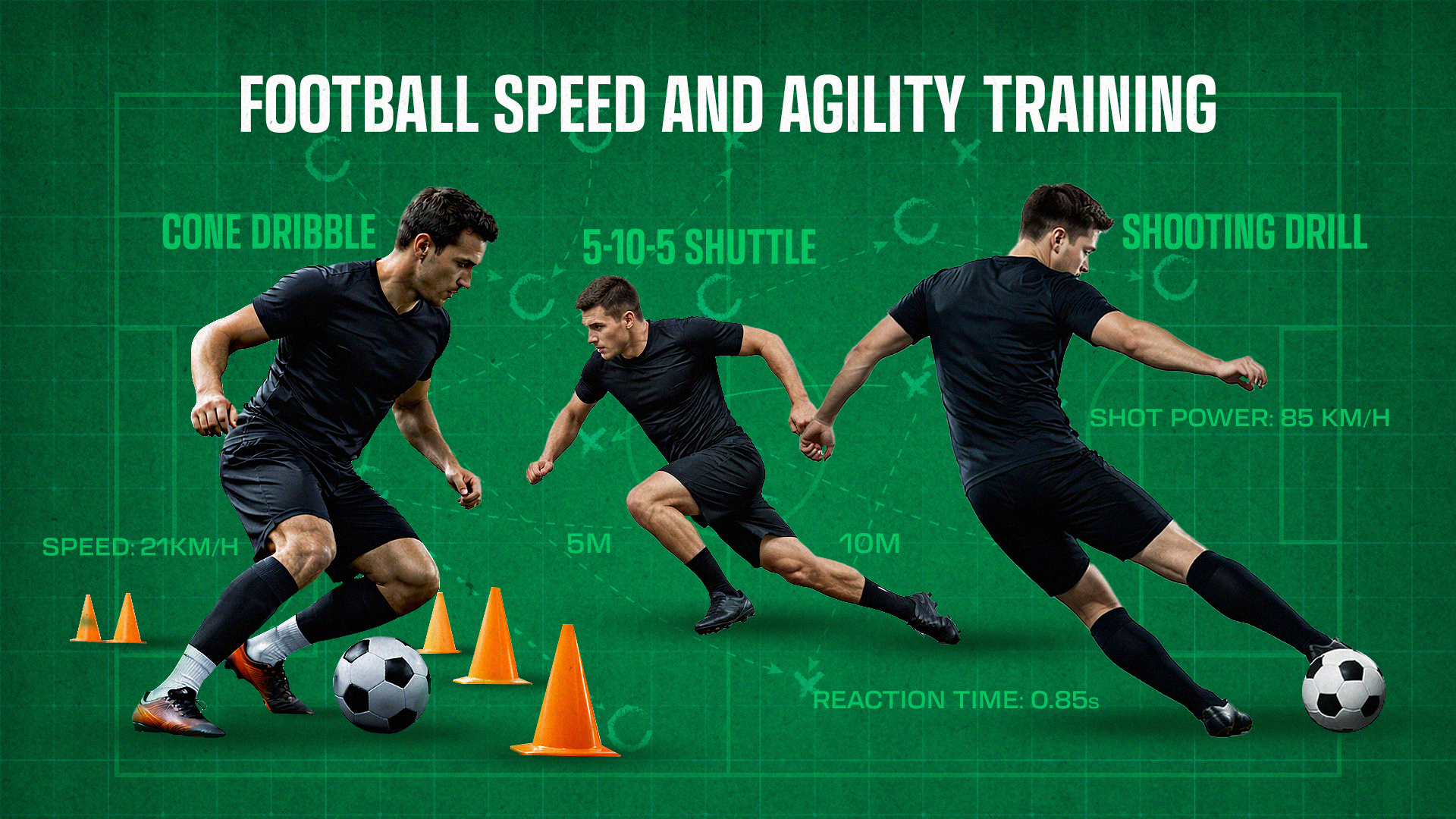
Dribbling drills form another essential component of early training. The classic cone-weave drill remains widely used, where players dribble through a line of cones placed two to three meters apart. The exercise develops close control, rhythm, and coordination while maintaining forward momentum.
Academy programs such as La Masia emphasize frequent ball contact during early development. Young players often perform hundreds of touches per session to build technical comfort and improve ball mastery.
Position-Specific Training: Developing Tactical Roles
As players progress, training becomes more specialized according to positional roles on the pitch. Strikers, midfielders, defenders, and goalkeepers all require different movement patterns and technical responsibilities.
For attacking players, striker training drills are designed to simulate match-like scenarios where finishing must occur under pressure. Many professional academies use structured passing and shooting exercises to develop timing and movement inside the penalty area.
A common exercise is the four-cone shooting drill, where cones form a rectangle outside the penalty area. Players perform quick passing combinations before finishing on goal. The drill develops shooting accuracy, quick decision-making, and coordinated attacking movement. Repeated variations encourage players to practice different types of finishes such as driven shots, placed efforts, and first-time strikes.
Goalkeepers follow a separate training methodology that combines technical and athletic preparation. Modern goalkeeping requires not only shot-stopping ability but also distribution skills and positional awareness during build-up play. Coaches often structure goalkeeper training sessions around reaction drills, positioning work, and distribution exercises.
Goalkeeping specialists like Frans Hoek have long emphasized the importance of balancing these areas so that goalkeepers can contribute effectively to both defensive and attacking phases of the game.
Speed and Agility Drills: Building Athletic Performance
Speed and agility are trainable qualities that can significantly improve through structured training. Sports science research shows that well-designed sprint and agility programs can increase acceleration and change-of-direction efficiency over time.
One widely used drill is the 5-10-5 shuttle run, also known as the pro-agility drill. Three cones are placed five yards apart, and players sprint, change direction, and accelerate repeatedly between them. The drill focuses on deceleration control, rapid re-acceleration, and directional balance.
Another commonly used exercise is the three-cone or “L-drill,” which develops hip mobility and body control while players perform sharp directional changes at speed. These drills strengthen the mechanical foundations needed for quick movements during matches.
Unlike track sprinting, football speed training emphasizes multidirectional movement. Players must accelerate, decelerate, and react to unpredictable game situations within seconds. For this reason, strength and conditioning coaches incorporate drills that mimic real match conditions rather than purely linear sprint work.
Reactive Agility and Game-Realistic Movement
True agility in football involves reacting to external stimuli such as the ball, teammates, or opponents. Training programs therefore combine closed drills with open, reactive scenarios.
Partner chase drills are widely used to simulate competitive situations. In straight-line variations, one player starts with a small advantage while the second player attempts to close the gap over a short sprint distance. Other variations involve lateral mirror drills, where players must react instantly to an opponent’s directional changes.
Coaches such as Antonio Conte and Diego Simeone incorporate reactive agility exercises extensively in training sessions. These drills help players develop decision-making speed while maintaining physical balance and coordination under pressure.
Using Performance Data to Improve Training
Modern football training increasingly integrates performance analytics alongside traditional drills. Video analysis and AI-driven tracking tools help coaches measure sprint distances, acceleration patterns, and movement efficiency during training sessions.
Platforms like StepOut allow coaches to analyze match and training footage to identify how effectively players apply speed and agility skills during real game situations. By combining physical training with performance data, coaches can refine drills, monitor player development, and design more targeted training programs.
This analytical approach ensures that athletic development translates directly into improved match performance.
Conclusion
Speed, agility, and positional intelligence are essential qualities for success in modern football. From beginner drills focused on ball control and coordination to advanced training exercises used by professional teams, each stage of development contributes to building a complete player.
The most effective training programs combine technical work, athletic conditioning, and tactical awareness into a structured progression. When players consistently practice purposeful drills and apply them in game situations, they develop the explosive movement and decision-making required at higher levels of competition.
Ultimately, mastering speed and agility is not just about running faster—it is about moving smarter, reacting quicker, and executing actions with precision in every phase of the game.
Frequently Asked Questions
Why are speed and agility important in football training?
Speed and agility help players accelerate, change direction quickly, and react effectively to match situations, improving both attacking and defensive performance.
What are the best football drills for beginners?
Beginner drills usually focus on ball control, dribbling through cones, spatial awareness exercises, and basic movement coordination.
How do professional players train for agility?
Professional players perform structured drills such as shuttle runs, cone drills, and reactive partner exercises that simulate real game movements.
Can data analytics improve football training?
Yes. Performance analytics platforms like StepOut allow coaches to analyze movement patterns, sprint data, and positional actions to refine training sessions.
How often should players practice speed and agility drills?
Most coaches integrate speed and agility training two to three times per week within regular training sessions to ensure balanced physical and technical development.
.png "The World Cup Moments That Defined Generations")