
The Format: How 54 Became 16
UEFA's revised qualification structure for 2026 featured 54 national teams drawn into 12 groups — six of four teams and six of five. The group-stage winner from each group earned direct qualification. The twelve runners-up, along with four Nations League group winners who had not already qualified directly, entered a 16-team playoff stage for the remaining four spots.
The Nations League playoff entrants for 2026 were Sweden, Romania, North Macedonia, and Northern Ireland. The 16 playoff teams were drawn into four paths of four, each featuring single-leg semifinals and a final, all in the March 2026 international window.
This format raised the competitive pressure significantly compared to previous cycles. Finishing second in your group was no longer a guarantee — it was an entry ticket to another knockout round.
The 12 Direct Qualifiers
The twelve group winners who secured automatic qualification were:
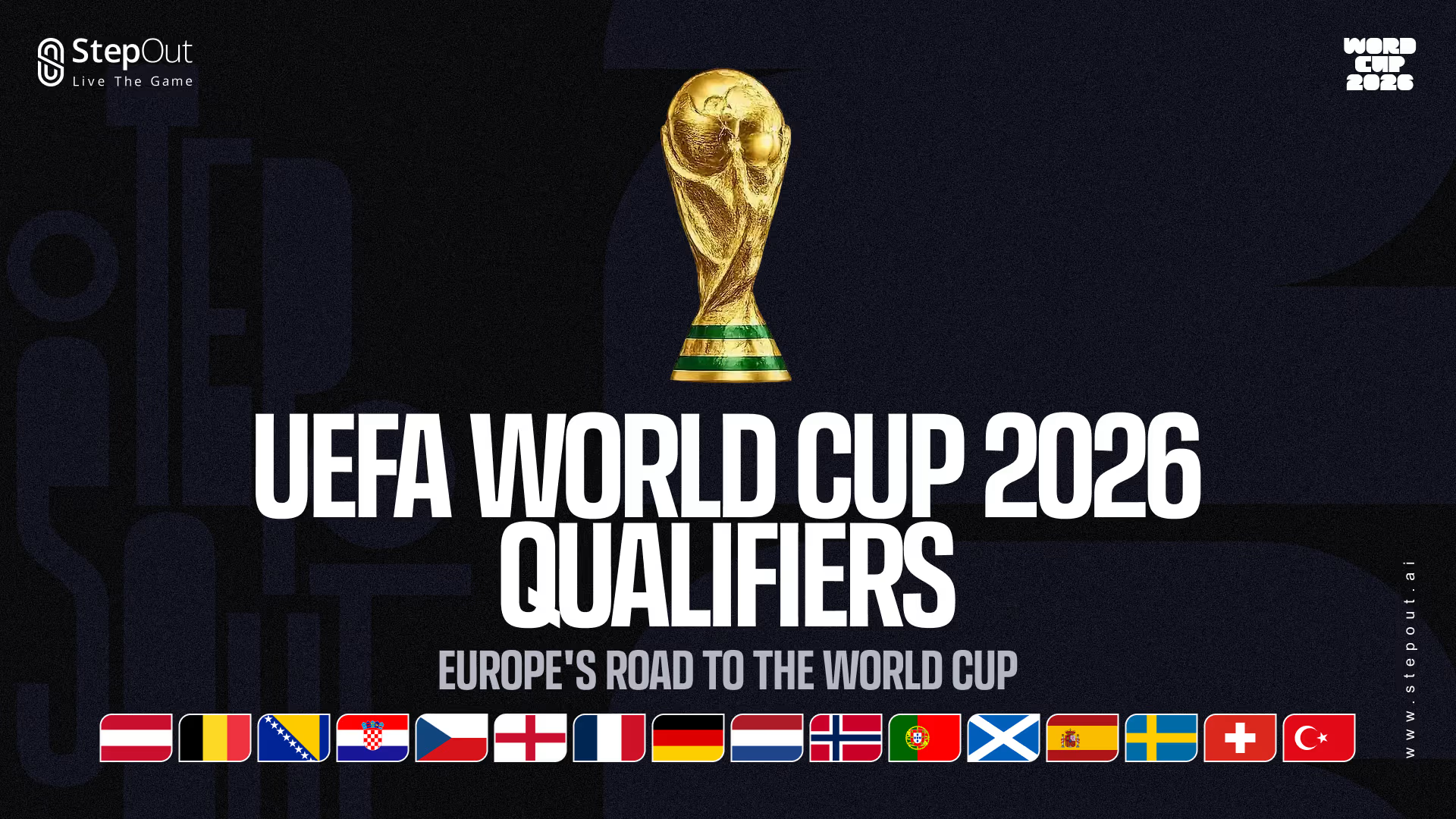
England, France, Germany, Spain, Portugal, Netherlands, Belgium, Austria, Norway, Switzerland, Scotland, Croatia.
Several of these required clinical late-season performances to close out their groups. Norway's qualification was built almost entirely on Erling Haaland's output — 16 qualifying goals from the centre-forward, the highest individual total in European qualifying. Scotland qualified for the World Cup for the first time since 1998, a milestone arrived at through a mixture of collective discipline and the Premier League-derived quality of their current generation.
Austria were arguably the cycle's most impressive direct qualifiers by points-per-game metrics, particularly in their defensive organisation — a side built on Bundesliga structural principles who outperformed their seeding consistently.
The Playoff Stage: Four Paths, Four Qualifiers
The UEFA playoff drew 16 teams into four paths, with the final four World Cup spots decided in March 2026.
Path A produced the tournament's most dramatic result: Bosnia-Herzegovina beat Italy on penalties in the final, eliminating the four-time world champions from a third consecutive World Cup. Italy had beaten Northern Ireland in the semifinal. Wales faced Bosnia in the other semi, with Bosnia progressing after a penalty shootout. Italy's failure to qualify carries implications beyond the tournament itself — it represents the third cycle in succession in which one of soccer's historically dominant nations has failed to navigate a revised UEFA playoff structure.
Path B sent Sweden to the World Cup via a 3-2 win over Poland in the final — a result that capped a remarkable qualification cycle for a side who had entered via Nations League pathway after finishing outside the top two in their group. Poland's elimination, despite their talent pool, reflected the structural disadvantage of playoff-path positioning.
Path C sent Türkiye through, defeating Kosovo in the final.
Path D saw Czechia qualify, completing the four playoff spots and eliminating Denmark — a result that sent significant analytical shockwaves through European soccer circles.
Italy and Denmark: The Exits That Define the Cycle
No analysis of UEFA qualification for 2026 is complete without addressing both exits in context.
Italy's situation is structurally complex. Their domestic league has not consistently produced an elite pressing generation — the technical quality exists, but the collective tactical evolution that defines the current European vanguard has developed elsewhere. Their squad construction leans on individual brilliance over collective intensity, and in a single-leg playoff format where press-resistance and transition speed determine outcomes, that imbalance is exposed.
Denmark's exit is arguably more surprising analytically. Their qualifying campaign was tactically consistent and physically competitive. Their elimination by Czechia in the playoffs reflects the fundamental unpredictability of single-leg knockout soccer, where a full campaign's accumulated data can be rendered irrelevant by a 90-minute outlier performance.
Tactical Trends Across the European Qualifying Cycle
Several patterns emerged clearly across the campaign that are relevant beyond the qualification outcomes themselves.
High-intensity pressing nations dominated group stages. Germany, France, England, and Spain — all direct qualifiers — share a tactical identity built around controlling pressing triggers and suffocating opponents in their own half. Nations who qualified by defending deep and using transition were more likely to need the playoffs.
Set-piece conversion became a decisive differentiator. Across the 204 qualification matches played, teams who ranked in the top tier for aerial conversion from set pieces — England, Austria, Norway — accumulated points disproportionately relative to their open-play dominance. This reflects a broader pattern in high-stakes soccer: when technical quality is comparable, set-piece execution creates separation.
Squad depth separated direct qualifiers from playoff sides. Teams that qualified through the group stage tended to show lower variance in performance across matchdays — indicating greater squad homogeneity and tactical flexibility. Playoff sides more often featured boom-and-bust performance profiles: dominant in home fixtures, inconsistent away. Data-driven squad assessment tools increasingly identify this pattern as a structural marker of teams that are built for qualification but not for tournament soccer.
Norway: The Qualification Cycle's Defining Story
Norway ended a 28-year World Cup absence, powered by the most statistically dominant individual qualification performance in European soccer: Haaland's 16 goals transformed matches that Norway might otherwise have drawn or lost into decisive wins. His aerial dominance, movement in the box, and finishing efficiency across a nine-match cycle produced numbers that no defensive scheme consistently neutralised.
But the deeper story is what the squad around Haaland has become. Martin Ødegaard's creative control from midfield, combined with Norway's tactical discipline in defensive transitions, produced a side with genuinely cohesive structural identity — not just a striker with support players. Their World Cup campaign will be measured by whether they can maintain that coherence against opponents with the pressing quality to isolate Haaland from service.
Scotland's Return: 28 Years in the Making
For Scotland, qualification represents more than a World Cup spot. The 1998 finals in France marked the last time they appeared on soccer's biggest stage. This generation — built around the extraordinary Premier League contribution of Andy Robertson and a cohort of domestically developed talent — qualified through tactical conviction rather than individual brilliance.
Their direct qualification, won through group stage consistency, reflects a squad that has learned to play without the ball as effectively as with it. Their group at the World Cup — Brazil, Morocco, Haiti — provides no favourable matchups, but Scotland arrive with the psychological confidence of a side that has earned the right to be present.
The 16 Qualifiers: Full List
Direct (Group Stage): England, France, Germany, Spain, Portugal, Netherlands, Belgium, Austria, Norway, Switzerland, Scotland, Croatia.
Via Playoff: Bosnia-Herzegovina, Sweden, Türkiye, Czechia.
Notable Exits: Italy (eliminated in Path A playoff final), Denmark (eliminated in Path D playoff final).
What the Qualified Field Tells Us
UEFA sends its most technically complete field in years to North America. Sixteen teams spanning a genuinely wide tactical range — from Spain's press-and-possession identity to Bosnia's direct, physical counter-attacking structure — will arrive in the World Cup with different qualification stories but equivalent ambition.
The absence of Italy is historically significant. The presence of Norway, Scotland, Bosnia-Herzegovina, and Czechia adds tactical variety and underdog narrative to a European contingent that might otherwise be dominated by familiar names. Underlying performance metrics from the qualification cycle show that several of the direct qualifiers — Austria, Croatia, Scotland — arrived at the playoffs having absorbed pressure consistently well, metrics that translate to genuine tournament durability.
The European qualification cycle confirmed what data models consistently project: the teams best equipped for tournament soccer are not always those with the highest individual talent concentration. Collective pressing efficiency, set-piece delivery, and tactical flexibility across a compressed schedule determine outcomes more reliably than star-player quality in isolation.
Conclusion
Europe's road to the 2026 World Cup produced exactly the kind of complexity the revised format was designed to create. Fifty-four nations, 204 qualification matches, and a playoff stage that eliminated historic powers while advancing surprising qualifiers — all of it reflecting the increasingly competitive depth of continental soccer. The sixteen teams who arrive in North America carry the continent's collective ambition, and the analytical evidence from their qualification campaigns suggests the European group will be among the tournament's most tactically diverse.
.png "The World Cup Moments That Defined Generations")