

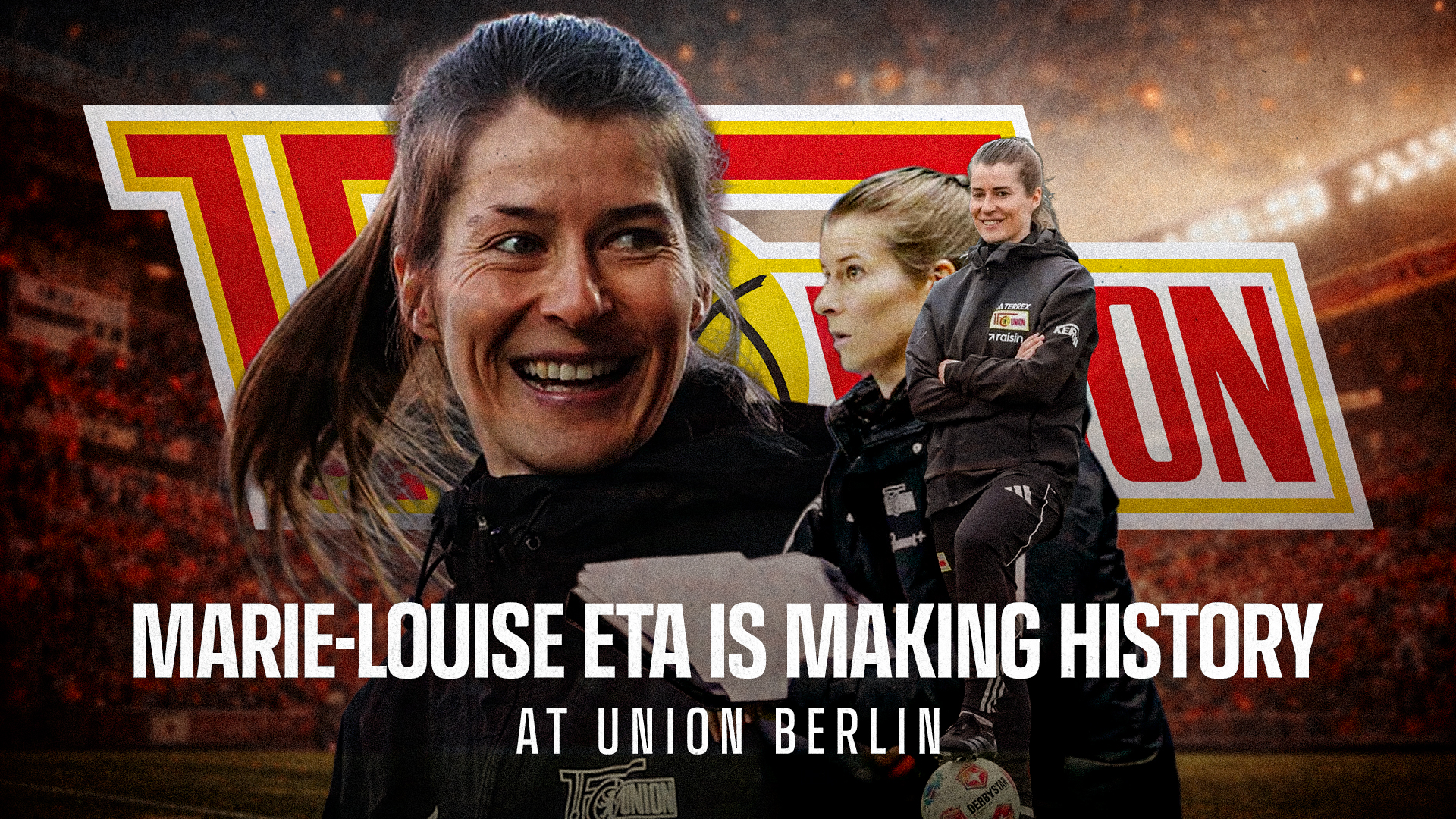
How Marie-Louise Eta’s rise reflects changing pathways in soccer
A Historic Shift in the Dugout
Why Marie-Louise Eta Earned Her Place at Union Berlin
There is a moment in soccer, the kind that happens only a handful of times in a generation, where the sport does something that feels genuinely new. Something that changes what is possible. On April 11, 2026, Union Berlin made Marie-Louise Eta the interim head coach of their men's Bundesliga side, and for the first time in the history of Europe's top five leagues, a woman was sitting in the head coach's chair. Headlines understandably went wild, but many of the comments overlooked something important: this change was not a radical gamble made by a club running out of ideas. Union Berlin knew her for a long time; they knew what they were getting, along with what it could mean for the world of soccer. So how did Marie-Louise end up here? And most importantly, why is it based on merit?
The Context of Union Berlin
Steffen Baumgart had just been sacked following a 3-1 defeat to bottom side Heidenheim. Union were 11th in the table, having won only two of their last 14 league games. Five matches left in the season. A six-point buffer above the relegation play-off spot that could disappear quickly if things continued the way they were going. In that situation, any club wants someone who knows the dressing room, understands the squad, and can communicate their soccer ideas clearly. Eta ticked every one of those boxes. She had been at Union Berlin since 2023, first as assistant coach under Marco Grote, then working alongside Nenad Bjelica, and most recently running the men's U19 side. She was already scheduled to take over as head coach of the women's team in the summer. The decision to hand her the men's first team until the season's end was, in the words of sporting director Horst Heldt, about quality first and foremost. "We have 100 per cent confidence in Loui, complete conviction," Heldt said. Anyone who has followed Union Berlin closely enough would find that entirely believable.
Who is Marie-Louise Eta
Before looking at what this appointment is, it is worth understanding who Eta is as a soccer player and coach, because this is her first rodeo in the game. Born in 1991, Eta came through as an energetic midfielder and made her senior debut for Turbine Potsdam at just 17. That stint at Potsdam, where she played under her maiden name Bagehorn, produced the high point of her playing career. In 2010, she was part of the Turbine Potsdam squad that won the UEFA Women's Champions League, beating Lyon on penalties in the final. She also collected three consecutive Frauen-Bundesliga titles from 2009 to 2011 and two DFB-Hallenpokal trophies during that period. From Potsdam, she moved to Hamburg, then Cloppenburg, and later captained Werder Bremen before injuries forced her into retirement in 2018 at just 26. She had also represented Germany at the youth level, appearing in the UEFA Under-19 European Championships in both 2009 and 2010. After her injury, rather than stepping away from soccer, she stepped towards coaching with the same energy she had brought to the pitch.
Her Coaching Path
After hanging up her boots, Eta began coaching in the youth setup at Werder Bremen. She became, at the time, the only female coach working in the academy system of a men's Bundesliga club. She said back then that quality is the only thing that matters on the training pitch. "It doesn't make me proud because I'm the only woman. As a person, I am happy that I can do this job. I don't see any difference whether a man or a woman works in youth soccer. The quality of the coach on and off the pitch is crucial." Eta said back in 2018. She also coached Germany's women's youth sides, working with the U15, U17, and U19 teams at the national level. So by the time she arrived at Union Berlin in 2023, Eta had already spent the better part of five years developing players across multiple age groups and environments. At Union, she became the first woman to serve as assistant coach at a men's Bundesliga club. First woman to serve in a first-team coaching role across any of Europe's top five leagues. In the 2023/24 season, when Bjelica served a suspension, she stepped in as acting head coach, and Union won the game. That result did not get nearly enough attention at the time. She then took charge of Union's U19s this season. By all accounts, the side played progressive, high-energy soccer with a clear identity. People who followed them consistently praised the quality of the work being done with that squad. This is a person with a Champions League winner's medal as a player, national team coaching experience, first-team Bundesliga experience, and a year of running a men's youth side at the same club. The case for giving her the job was already sitting there before anyone had to make it.
What the Noise Was All About
When the appointment was announced, the expected corners of the internet did what they always do. Sexist abuse flooded in from the usual chorus from people who have likely never attended a coaching session in their lives. Union Berlin's social media team handled it brilliantly, and Heldt addressed it directly, calling the abuse "embarrassing" and "insane." His defence of Eta was not the careful, PR-managed statement you sometimes see in these situations. It had a sense of genuinity from someone who found the discussion beneath the reality of what had actually happened. The response from inside the club was, reportedly, overwhelming support. A source close to the club described it as among the most universally well-received appointments they had seen. That is worth noting. These are people who know Eta, who have trained with her, who have seen her work up close. Sarina Wiegman, England's women's head coach, summed it up cleanly: "She's a trailblazer. I think this was only a matter of time anyway. It shows that soccer is moving up."
Why Timing Matters More Than It Seems
Some have said this was inevitable, that it was only a matter of time before a woman managed a men's top-flight team, but when you consider the bigger picture, not many clubs would have taken that step forward. The Premier League does not have a single female coach on any first-team staff. In England, Hannah Dingley was appointed caretaker at Forest Green Rovers in 2023 but never managed a competitive fixture before she was replaced. Emma Hayes, one of the most respected soccer minds in the world, once said bluntly that men's soccer was not ready for female coaches. Germany has shown a different approach toward this. Sabrina Wittmann took charge of Ingolstadt in the third division in 2024 and is now heading into her second season there. The Bundesliga has created a culture where these appointments are possible, and Union Berlin has been at the forefront of that. But even within that context, Eta's situation is unique. She is managing a men's Bundesliga club in front of millions of viewers across more than 200 countries. Every game she coaches from that dugout will be seen by a generation of young women who have never had this kind of reference point.
The Job Itself
It is easy to get swept up in the symbolism. Eta herself has made clear she would rather not. "Our place in the Bundesliga is not yet secure," she said after the appointment. "I am delighted that the club has entrusted me with this challenging task." She will lead the first team until the end of the season, after which she is due to take over the women's side. There is a scenario, of course, where a strong finish changes those plans. But even without that, what she is doing right now matters beyond this season or this club.
The Bigger Picture
There is something telling in the fact that this happened at Union Berlin. This is a club built on an identity of working class, community-driven, and unconventional. They have always done things their own way. Trusting Eta with their first team is consistent with who Union Berlin are. They looked at who was in front of them, who knew their players and their system, who had already shown they could manage in their environment. The answer was Eta. That is how progress tends to actually happen. Not through grand symbolic gestures, but through clubs with the confidence to make the obvious call, even when the obvious call looks unfamiliar to some. Regardless of what the future holds, it is clear that Marie-Louise Eta has earned this, every step of the way.
.png "The World Cup Moments That Defined Generations")