
1982–1994: Redemption, Genius and Heartbreak
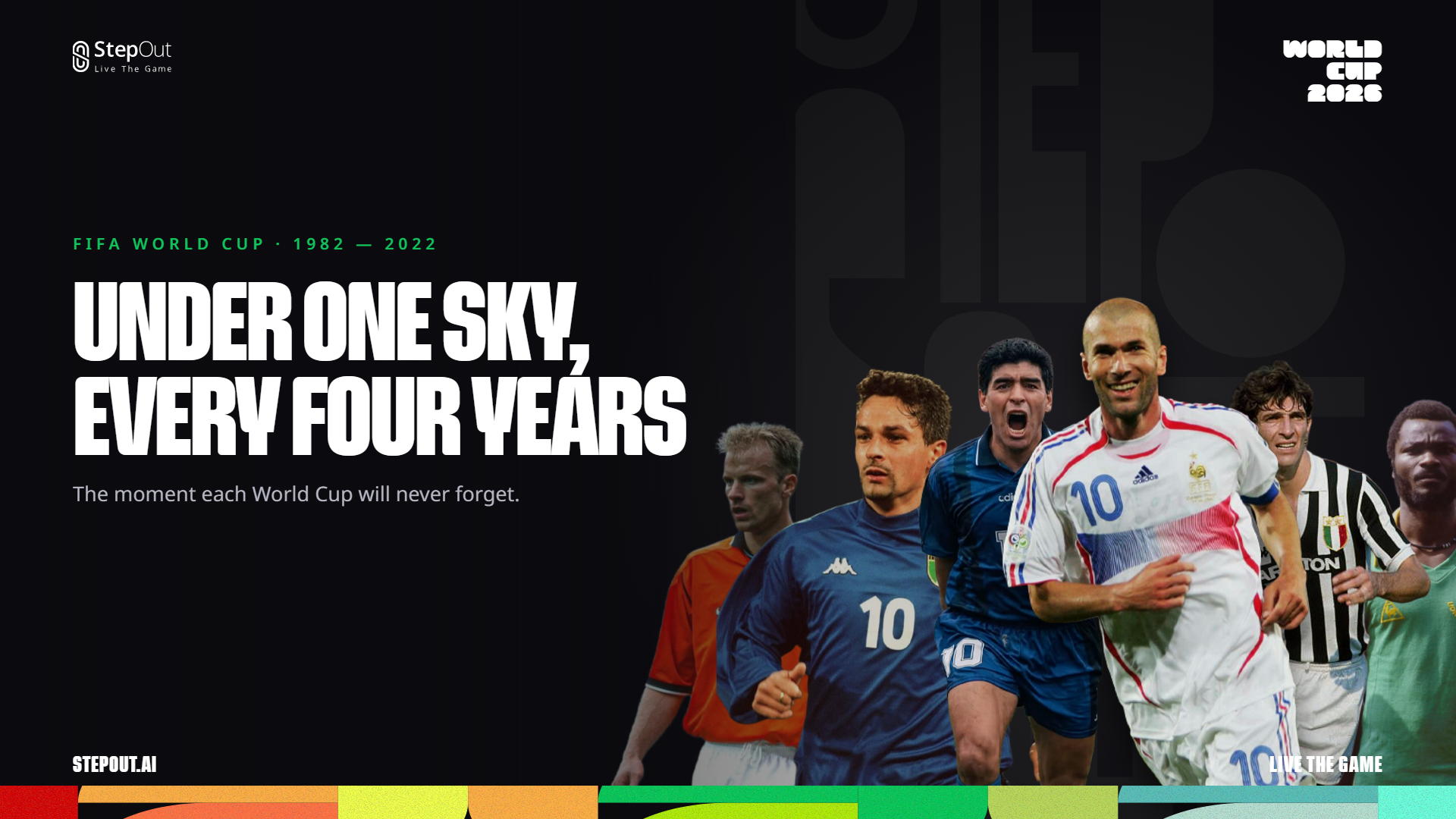
The World Cups between 1982 and 1994 produced some of the sport's most unforgettable stories. In Spain 1982, Paolo Rossi arrived with questions surrounding his form but answered them in spectacular fashion. His famous hat-trick against Brazil eliminated one of the greatest teams ever assembled before inspiring Italy to lift the trophy. Four years later, Diego Maradona delivered perhaps the most iconic performance in football history against England. Within four minutes, he scored the controversial "Hand of God" goal before producing the extraordinary solo effort that FIFA later recognised as the "Goal of the Century." Italia '90 introduced another legendary figure. At 38 years old, Roger Milla came off the bench to lead Cameroon to the quarter-finals, making them the first African nation to reach the last eight of a FIFA World Cup. Then came USA 1994, where football witnessed one of its most heartbreaking images. After 120 goalless minutes, Roberto Baggio stepped up in the penalty shootout only to send his effort over the crossbar, handing Brazil their fourth World Cup while creating one of football's most enduring photographs.
2002: Senegal Shock the Champions
Few opening matches in World Cup history have produced a bigger surprise than Senegal's victory over defending champions France in 2002. Making their tournament debut, Senegal defeated the reigning world champions 1-0 through Papa Bouba Diop's famous winner, announcing themselves to the footballing world in spectacular fashion. Rather than being a one-off upset, the victory became the foundation of an extraordinary campaign. Senegal advanced to the quarter-finals, matching the best World Cup performance by an African nation at the time. France, meanwhile, endured one of the worst title defences in tournament history, failing to score a single goal before being eliminated in the group stage.
2006: Zidane's Final Act
The 2006 World Cup final should have been remembered solely as the perfect farewell for Zinedine Zidane. Playing the final match of his career, he gave France the lead with a memorable Panenka penalty before producing another masterclass in midfield. Everything changed during extra time. Following an exchange with Marco Materazzi, Zidane turned and headbutted the Italian defender, receiving a red card in the final match of his career. France went on to lose the penalty shootout, and Zidane's lonely walk past the World Cup trophy became one of the defining images in football history. Despite the dramatic ending, he still received the Golden Ball as the tournament's best player.
2010: Ghana's Cruelest Moment
South Africa 2010 nearly delivered one of the greatest achievements in African football history. Ghana stood seconds away from becoming the first African nation to reach a World Cup semi-final when Luis Suárez deliberately handled a goal-bound effort on the line during extra time. The handball resulted in a penalty and a red card, giving Asamoah Gyan the opportunity to send an entire continent into celebration. His effort struck the crossbar. Uruguay survived before winning the penalty shootout, while Ghana's dream disappeared in one of the cruellest endings the World Cup has ever produced. More than a decade later, it remains one of the tournament's most debated moments.
2014: The Mineirazo
Brazil entered the 2014 FIFA World Cup believing home advantage would lead them to a sixth title. Instead, they experienced the most painful defeat in their football history. Germany stunned the hosts with five goals in the opening 29 minutes before eventually winning 7-1 in Belo Horizonte. The result became known as the "Mineirazo," echoing the heartbreak of the famous "Maracanazo" from 1950. During the same match, Miroslav Klose also became the World Cup's all-time leading goalscorer with his 16th tournament goal, adding another historic milestone to an unforgettable evening.
2018: Croatia's Greatest Journey
Croatia arrived in Russia as outsiders but left having inspired football fans around the world. Guided by Luka Modrić, they battled through three consecutive knockout matches that extended beyond 90 minutes, defeating Denmark, Russia and England to reach the first World Cup final in the nation's history. Although France ultimately claimed the title, Croatia's remarkable journey demonstrated how tactical discipline, resilience and collective belief could overcome nations with far greater resources. Modrić's performances earned him the Golden Ball and later the Ballon d'Or, ending the decade-long dominance of Lionel Messi and Cristiano Ronaldo.
2022: Morocco Makes History
The 2022 FIFA World Cup produced one of the greatest underdog stories the tournament has ever seen. Morocco became the first African and Arab nation to reach a World Cup semi-final, defeating Belgium, Spain and Portugal along the way. Led by defensive organisation, tactical discipline and outstanding performances from players such as Achraf Hakimi and Yassine Bounou, Morocco united supporters across Africa, the Middle East and beyond. Their historic run represented far more than football, becoming a symbol of belief and progress for entire regions that had waited decades for a breakthrough on the world's biggest stage.
Why These Moments Live Forever
World Cup champions are remembered, but defining moments are remembered forever. Fans think of Maradona before they remember Argentina lifting the trophy in 1986. They remember Zidane's headbutt before recalling Italy's celebrations in 2006, and they remember Brazil's 7-1 defeat before Germany's triumph in 2014. That is what makes the FIFA World Cup unique. Every tournament produces a story that lives beyond the final result, passed from one generation of supporters to the next. As new heroes emerge and new history is written every four years, these moments continue to remind us why the World Cup remains football's greatest stage.